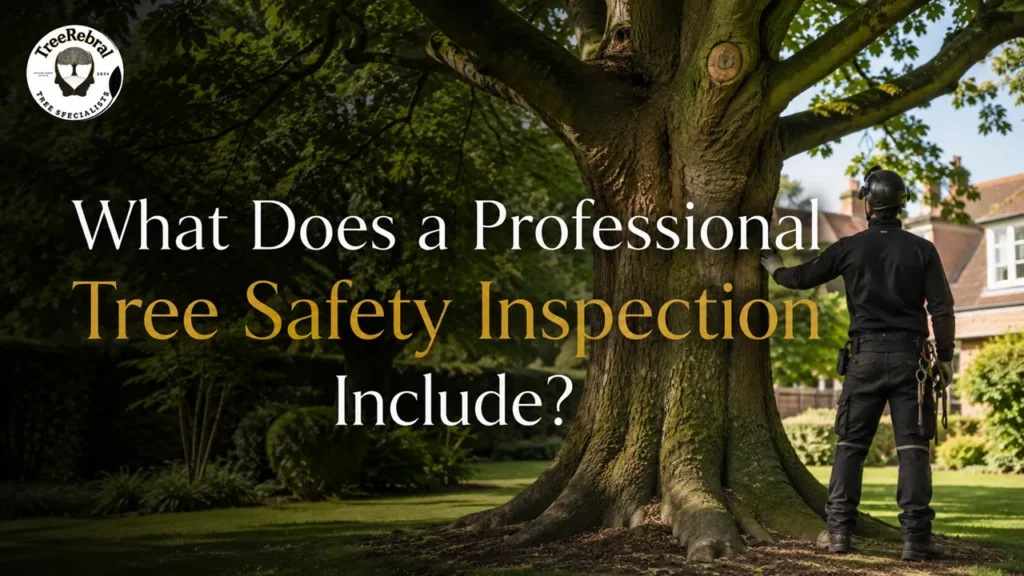
A tree safety inspection normally considers the tree from its surrounding ground and visible roots through the trunk, branch structure and crown. The inspector looks for significant defects such as cracks, decay, damaged roots, weak unions or dead branches, then considers what people or property could be affected if part of the tree failed.
Finding a defect does not automatically mean removal is required. The outcome may instead be monitoring, pruning, further investigation or no immediate work.
What Is a Tree Safety Inspection?
A professional inspection is a structured assessment of a tree’s visible condition and the significance of anything unusual that is found. It looks at both biological health and structural condition rather than judging a tree simply by its height, age or appearance.
The surrounding site is also important. UK tree-risk guidance stresses that tree condition has to be considered alongside the potential consequences of failure, including the presence of people and property.
TreeRebral provides professional tree surgery across Poole, Bournemouth and Christchurch, including tree-health assessment and management where work is appropriate.
The Inspection Starts Before Looking at the Tree
A useful assessment begins with context. The same structural feature can have very different significance depending on where the tree stands.
A mature tree beside a rarely used corner of a large garden creates a different management situation from a similar tree beside a busy pavement, driveway, building entrance or frequently occupied outdoor space.
The inspector may therefore consider recent construction, excavation, changes in ground level, nearby buildings, roads, paths, parked vehicles and how often people use the surrounding area.
This relationship can be summarised simply:
tree condition + likelihood of failure + surroundings = management significance
The Arboricultural Association distinguishes high occupancy from high tree risk. A busy location alone does not make a tree dangerous because the likelihood of failure must also be considered.
What Does a Tree Safety Inspection Include?
A tree safety inspection generally works systematically through the tree and its immediate surroundings rather than concentrating on one visible symptom.
| Area Inspected | What May Be Considered |
| Surrounding site | Buildings, paths, roads, recent construction and use of the area |
| Roots and ground | Visible root damage, excavation, soil cracks and root plate movement |
| Trunk | Cracks, cavities, wounds, bark condition and visible decay |
| Branch unions | Splits, weak attachments and structural abnormalities |
| Crown | Deadwood, broken limbs, dieback and canopy balance |
| Foliage | Abnormal growth, sparse leaves and signs of decline |
| Previous management | Historic pruning, storm damage and changes around the tree |
| Potential targets | People, vehicles, property and frequently used areas |
| Overall condition | Whether monitoring, tree work or further assessment may be appropriate |
The table is not a diagnostic checklist for homeowners. Features have to be interpreted together rather than treated as individual pass-or-fail signs.
Reading the Tree from Ground to Crown
The physical assessment usually follows the structure of the tree. This helps connect visible symptoms with possible structural or physiological causes.
Roots and the Rooting Environment
Much of a tree’s root system is hidden, so a ground-level inspection cannot reveal every root problem. It can, however, identify evidence such as severed or exposed roots, disturbed soil, ground cracking, excavation damage, compaction or movement around the root plate.
Recent building works, trenching or changes to ground levels can also be relevant because roots may be damaged without obvious symptoms appearing immediately. Current NTSG guidance notes that root disturbance can affect both tree health and anchorage and that symptoms may emerge later.
Trunk and Main Stem
The trunk is checked for features such as cracks, cavities, wounds, dead bark, splits, abnormal growth and weak unions between stems.
Fungal fruiting bodies may also be recorded because some fungi are associated with wood decay. Their significance depends on factors such as the fungus involved, its position and the wider condition of the tree. A fungal bracket is evidence to investigate, not an automatic instruction to fell the tree.
Branch Unions and Crown
Higher in the tree, the inspector considers branch attachments, broken limbs, hanging branches, deadwood, crown dieback and obvious imbalance.
Previous pruning can also affect how the crown is interpreted. Old cuts, topping damage or substantial regrowth may alter branch structure and influence future management.
Foliage and Visible Vitality
Leaf density, shoot growth and crown condition can provide useful information about tree vitality. Sparse foliage or dieback may indicate stress, but the visible symptom alone does not identify the exact cause.
Weather, root damage, disease, waterlogging and other environmental factors can produce similar outward signs.
A Defect Is Evidence, not a Verdict
One of the most important parts of professional inspection is deciding whether a feature actually represents a meaningful concern.
A large tree is not automatically dangerous because of its size. Similarly, a tree should not be condemned solely because it is old, leaning or contains a cavity.
What About a Hollow Tree?
A hollow trunk can look alarming, but hollowing does not automatically make an old tree structurally unsound. The National Tree Safety Group explains that mature trees can retain functional outer wood and adaptive growth even when substantial internal wood has decayed.
The amount, position and progression of decay therefore need interpretation within the tree’s wider structure.
Does Deadwood Mean the Whole Tree Is Dying?
No. Individual branches naturally die and are shed during a tree’s life. The significance changes where deadwood is large, extensive, hanging over a frequently used area or associated with wider crown decline.
Property owners concerned by recent changes can also review common signs of tree problems before arranging an assessment.
Can Every Problem Be Found Visually?
No. Every visual tree safety inspection has limitations because some defects are concealed within wood, below ground or high in the crown.
A routine inspection may identify evidence that justifies closer investigation without establishing the full extent of the problem immediately.
LANTRA’s Professional Tree Inspection framework recognises that advanced inspectors may need to recommend aerial inspection or specialist decay-detection methods where visible evidence cannot answer the management question.
Depending on the circumstances, further work might involve a closer aerial assessment, probing, sounding or specialist internal investigation. These techniques are not required for every tree and should not be presented as routine parts of every inspection.
What Happens After the Tree Has Been Inspected?
The purpose of inspection is to support a proportionate management decision. It does not automatically lead to tree surgery.
Possible outcomes include:
- No immediate intervention: No significant issue requiring current work is identified.
- Monitoring: A feature is recorded so changes can be reviewed later.
- Selective tree work: Deadwood removal, pruning or another appropriate intervention may be advised.
- Further investigation: More information is required before deciding what action is justified.
- Removal: This may be considered where significant defects cannot reasonably be managed while retaining the tree.
Where pruning or removal becomes a realistic option, the distinction between retaining a tree through reduction and removing it should be based on the individual tree rather than the presence of one symptom.
TreeRebral can assess visible tree condition and discuss suitable tree-management work where this falls within its tree-surgery services.
How Often Should a Tree Be Inspected?
There is no universal inspection interval suitable for every tree.
Frequency should reflect the tree’s condition, location, previous defects, changes in surrounding land use and how frequently people or property are present nearby. Current NTSG guidance states that there are no uniformly accepted inspection intervals appropriate to every situation.
Severe weather can also justify bringing an assessment forward where there has been visible branch damage, root movement or another significant change. NTSG guidance specifically notes that post-storm checks may be appropriate according to the severity of the event and site circumstances.
The key principle is that reinspection should respond to changing conditions rather than simply following the same fixed calendar forever.
Is a Tree Inspection the Same as a Tree Survey?
Not necessarily.
Everyday language often uses “inspection”, “assessment” and “survey” loosely, but professionally they can describe different scopes of work.
A condition check on an individual garden tree is not automatically the same as a BS 5837 development survey, mortgage report, subsidence investigation, woodland inventory or formal consultancy report.
LANTRA itself separates basic, professional and specialist internal tree-inspection training, illustrating why the required level of assessment depends on the question being asked.
For homeowners, the important step is to explain why the tree is being assessed so the appropriate type of professional input can be identified.
Tree Safety Inspection FAQs
Does a Tree Inspection Include the Roots?
It normally includes the visible rooting area and surrounding ground. An inspector may look for exposed or severed roots, soil movement and root plate changes, but underground conditions cannot always be established from the surface alone.
Can a Hollow Tree Still Be Retained?
Yes, in some circumstances. Hollowing can form part of the natural ageing process, and current UK guidance recognises that hollow trees can remain healthy and structurally strong depending on their form and condition.
Is a Leaning Tree Automatically Unsafe?
No. A long-established lean is different from evidence that the root plate or surrounding ground has moved recently. The lean needs to be interpreted alongside roots, trunk condition, crown balance and site history.
Does Fungal Growth Mean a Tree Needs Removing?
No. Fungal fruiting bodies can indicate decay and deserve professional interpretation, but their presence alone does not determine the correct management response.
Should Trees Be Checked After a Storm?
A check may be appropriate after significant weather where the tree or its surroundings have visibly changed. The need depends on storm severity, tree condition and the importance of the area beneath or around it.
Does a Tree Safety Inspection Always Lead to Tree Surgery?
No. An inspection may result in no immediate work, monitoring, further investigation or a proportionate pruning recommendation. Removal is only one possible outcome.
How Long Does a Tree Safety Inspection Take?
There is no useful universal duration. Time depends on the size and number of trees, accessibility, complexity of visible defects, site conditions and the required scope of assessment.
Use Inspection to Choose the Right Next Step
A tree safety inspection should answer more than whether a tree looks healthy. It considers the roots and surrounding ground, trunk, crown, visible defects and the people or property that could be affected.
The value lies in interpreting those observations proportionately. A cavity, lean, dead branch or fungal fruiting body may justify monitoring, remedial work or further assessment without automatically requiring removal.
TreeRebral provides professional tree care across Poole, Bournemouth and Christchurch. Where a mature, damaged or changing tree is causing concern, an assessment of its visible condition can help establish what action, if any, is appropriate before significant tree work is planned.