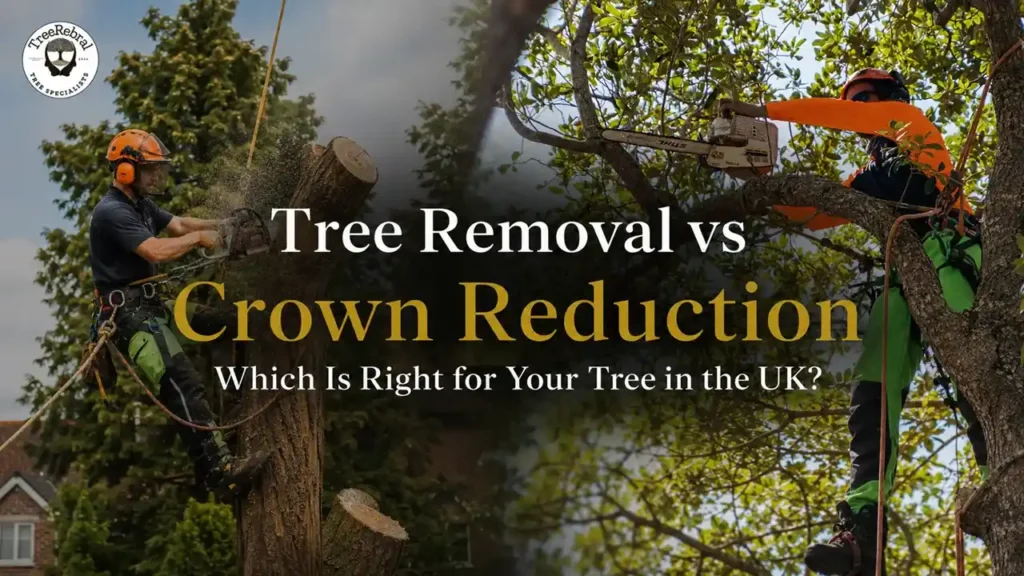
Tree removal vs crown reduction is usually a choice between retaining a manageable tree and removing one whose defects, location or condition cannot be reduced to an acceptable level. Crown reduction may suit a healthy tree that has outgrown its space, while removal may be more appropriate for a dead, severely decayed or structurally unstable tree.
TreeRebral works with homeowners across Poole, Bournemouth, Christchurch and wider Dorset. The right decision should follow an on-site assessment rather than being based only on height, shade or one visible defect.
Tree Removal vs Crown Reduction at a Glance
The two options solve different problems. Crown reduction changes the size and loading of the canopy while keeping the tree in place. Removal ends the tree’s life and clears the above-ground structure completely.
| Point of Comparison | Crown Reduction | Complete Removal |
| Main Purpose | Reduce height, spread or mechanical loading | Remove the whole tree where retention is unsuitable |
| Effect on the Tree | Retains the tree and a natural branch framework | Permanently removes the trunk and crown |
| Best Suited To | Healthy or manageable trees that have outgrown their position | Dead, failed or unacceptably hazardous trees |
| Future Work | Regrowth may need monitoring and further pruning | Stump treatment or grinding may be considered |
| Visual Result | A smaller canopy with the tree still present | Open space where the tree previously stood |
| Wildlife Impact | Retains more habitat and canopy cover | Removes habitat and canopy cover |
| Reversibility | Removed branches cannot be replaced, but the tree remains | The decision cannot be reversed |
| Permission | Consent may be needed for protected trees | Consent may also be needed before felling |
A professional specification should describe the intended reduction clearly, usually as a measured change in crown height or spread rather than a vague instruction to cut the tree back. The Arboricultural Association defines crown reduction as reducing the height or spread of the foliage-bearing crown to reduce mechanical stress, adapt the tree to its surroundings or reduce shading.
When Crown Reduction May Be the Better Fit
Crown reduction may be suitable when the tree is healthy enough to retain but its canopy has become too large for the available space. Selective cuts shorten branches back to suitable growth points, aiming to keep a balanced framework and recognisable natural form.
The Canopy Is Reaching a Roof or Boundary
A reduction may create practical clearance from buildings, roads or neighbouring land without losing the whole tree. The amount removed should reflect the species, branch structure and likely size of the pruning wounds, not simply the clearance a homeowner would prefer.
Wind Loading Needs Sensible Management
Reducing selected parts of the crown can lower mechanical loading on branches or the whole tree. It does not make a tree completely safe, and it cannot compensate for serious root-plate movement, advanced trunk decay or a failing main union.
Shade Is the Main Concern
A carefully specified reduction may lessen canopy spread and shading. Crown thinning is different because it removes selected smaller branches without substantially changing the tree’s overall height or spread.
Homeowners considering reduction, pruning or felling can review TreeRebral’s professional tree care service before arranging an assessment.
When Complete Removal May Be Necessary
Removal becomes more likely when the tree cannot be retained at an acceptable level of risk or when its position no longer allows practical long-term management.
- The Tree Is Dead: A dead tree cannot recover, and its branches and stem will continue to deteriorate.
- Decay Has Severely Weakened the Main Structure: Extensive decay in the trunk, major unions or root plate may leave too little sound wood for pruning to offer a workable solution.
- The Root Plate Is Moving: Fresh soil lifting, cracking around the base or a sudden new lean can indicate a loss of anchorage.
- A Main Stem Has Split: Some splits may be managed, but a major failure affecting the central structure can make removal the more realistic option.
- Storm Damage Is Beyond Remedial Pruning: A tree that has lost a large part of its crown or suffered major stem damage may no longer have a viable framework to retain.
- Repeated Reduction Will Not Resolve the Conflict: Regular heavy cutting can create large wounds and vigorous regrowth without solving the underlying problem.
Tree removal should not be recommended simply because a tree is tall, mature or close to a house. The condition of the roots, trunk and branch unions matters more than height alone.
A Large Tree Is Not Automatically Dangerous
Size can make the consequences of branch or whole-tree failure more serious, but size alone does not prove that failure is likely. A mature tree with sound roots, a stable trunk and well-attached branches may need monitoring or limited remedial work rather than removal.
The tree removal vs crown reduction question should start with the actual defect and whatever could be affected beneath the tree. A hanging branch above a drive may need removing, while a healthy canopy touching a roof could call for a limited reduction. Neither situation automatically justifies felling the whole tree.
A sudden lean, fresh cracks, moving roots or recently exposed decay deserves prompt inspection. A long-standing lean with stable ground and healthy growth may have a very different meaning.
What Crown Reduction Cannot Put Right
Crown reduction cannot restore dead wood, rebuild a decayed trunk or repair severed roots. It may reduce loading in selected cases, but it does not remove the underlying defect.
It also does not permanently stop a tree growing. Healthy trees respond to pruning with new growth, and some species produce vigorous shoots after heavy cutting. Future inspections and maintenance may form part of the decision.
Crown reduction should not be confused with topping. Topping uses indiscriminate cuts that can leave stubs, large wounds and poor regrowth. A proper reduction works back to suitable lateral branches and aims to retain a coherent crown.
How a Tree Surgeon Reaches the Decision
A proper tree removal vs crown reduction assessment considers the whole tree and its surroundings. The visible canopy is only one part of the decision.
Condition Comes Before Appearance
The inspection should consider vitality, deadwood, cracks, cavities, fungal fruiting bodies, weak unions, previous pruning and the condition around the root plate. The importance of each feature depends on where it sits and what could be affected if failure occurred.
Species Changes the Pruning Response
Tree species differ in growth habit, decay resistance and tolerance of pruning. A reduction that is proportionate for one species may create unsuitable wounds or excessive regrowth in another.
Location Shapes the Recommendation
Nearby roofs, roads, footpaths, neighbouring gardens and exposed coastal positions can all affect the specification. The aim is to solve the site problem with the least damaging work that remains practical.
What About Roots, Paving and Subsidence?
Crown reduction does not automatically stop roots growing or resolve damage to paving. Root growth responds to soil conditions, available moisture and the biology of the tree, so a smaller canopy should not be presented as a guaranteed root solution.
Tree removal does not automatically resolve a suspected subsidence problem either. The cause should be supported by suitable evidence, which may involve arboricultural, structural, soil and insurance input.
Where roots are lifting a path or affecting a wall, the options may include changing the surface, using a root-sensitive design, monitoring or carefully planned tree work. Cutting important roots without assessment can reduce stability and create a more serious concern.
Check Protection Before Choosing Either Option
A Tree Preservation Order can restrict cutting down, topping, lopping, uprooting, wilful damage or destruction without the local planning authority’s consent. Trees in conservation areas may also require prior notification before work starts.
The legal check applies to pruning as well as removal. TreeRebral’s guide to work on protected trees explains why a clear specification and supporting evidence matter when an application is required.
Other constraints may include planning conditions and protected wildlife. Permission and relevant ecological checks should be resolved before the planned work date.
Questions Homeowners Ask When Comparing the Options
Which Is Better: Tree Removal vs Crown Reduction?
Neither option is universally better. Crown reduction may preserve a healthy, manageable tree, while removal may be more appropriate where serious defects cannot be reduced to an acceptable level.
Can Crown Reduction Make a Tree Safer?
It can reduce loading on selected branches or the whole crown where the tree is suitable for the work. It cannot guarantee safety or repair serious decay, root instability or a split main stem.
Can a Diseased Tree Be Crown Reduced?
Sometimes. The answer depends on the disease, the amount of healthy structure remaining and whether pruning would help management or add further stress.
Should a Leaning Tree Be Reduced or Removed?
A lean needs context. A sudden lean with soil movement is more concerning than a long-standing lean with a stable root plate. An on-site inspection is needed before recommending either option.
Does Crown Reduction Stop Roots Growing?
No. Crown reduction does not permanently stop root growth and should not be presented as a guaranteed remedy for paving damage or subsidence concerns.
Is Crown Reduction the Same as Crown Thinning?
No. Reduction decreases the height or spread of the canopy. Thinning removes selected smaller branches to reduce density while broadly retaining the crown’s size and outline.
Can a Tree with a TPO Be Removed?
Possibly, but consent is normally required unless a relevant exemption applies. The application should explain the proposed work and the reasons for it.
Does Tree Removal Include Stump Grinding?
Not always. Felling removes the tree above ground, while stump grinding is a separate operation that reduces the remaining stump below the surrounding surface.
Choose the Option That Solves the Actual Problem
The best tree removal vs crown reduction decision is the least damaging option that addresses the real concern. A healthy tree that is simply oversized may be retained with a carefully planned reduction, while a dead or severely compromised tree may need controlled removal.
TreeRebral provides tree surgery across Poole, Bournemouth, Christchurch and wider Dorset. Homeowners can contact local tree surgeons in Dorset to arrange an assessment of the tree’s condition, location and realistic management options.
Before approving pruning or felling, check whether the tree is protected and review the official protected tree guidance.