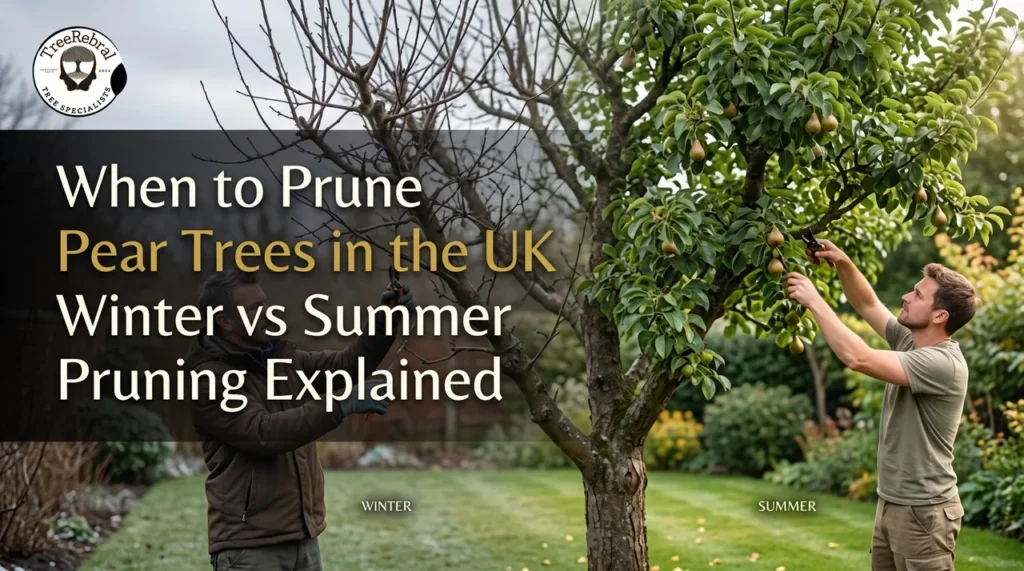
Knowing when to prune pear trees starts with one question: is the tree free-standing or trained?
Free-standing bush, standard and half-standard pear trees are generally pruned in winter, usually between November and early March while dormant. Trained pears such as cordons, espaliers, fans and pyramids are mainly pruned in late summer to control growth and maintain their restricted form.
So there is no single pruning month that is correct for every pear tree.
Identify Your Pear Tree Before Choosing the Pruning Season
The shape in which the pear is grown matters more than simply knowing that it is a Pyrus communis.
A free-standing pear develops a conventional tree crown and has room to form larger permanent branches. A trained pear is deliberately restricted along wires, a wall, fence or support structure.
That difference changes the purpose of pruning.
| Factor | Winter Pruning | Summer Pruning |
| Main pear type | Free-standing trees | Trained or restricted forms |
| Typical forms | Bush, half-standard, standard | Cordon, espalier, fan, pyramid |
| Typical UK timing | November to early March | Mainly late July to September |
| Tree state | Dormant and leafless | Actively growing |
| Main purpose | Maintain structure and productive wood | Restrict growth and maintain shape |
| Main growth managed | Branch framework and selected older growth | Current-season lateral shoots |
| Effect on vigour | Can stimulate stronger regrowth | Helps limit vegetative growth |
| Fruiting objective | Renew and organise productive structure | Improve light and promote fruiting spurs |
The distinction prevents one of the most common mistakes in pear tree pruning: applying the same technique to every pear simply because the species is the same.
Why Are Free-Standing Pear Trees Pruned in Winter?
Winter pruning suits an established free-standing pear because the tree is dormant and its branch structure is easy to see after leaf fall.
RHS guidance places routine winter pruning between November and early March. The aim is normally to maintain a productive, reasonably open crown rather than cut the tree back heavily each year.
A free-standing pear may need attention where branches are crossing, overcrowded, damaged or growing strongly into the centre. Selected older growth can also be renewed over time.
Winter pruning can stimulate growth, however. Cutting harder does not automatically mean more fruit.
If too much canopy is removed, a healthy pear may respond with vigorous vertical shoots rather than the balanced fruiting growth the homeowner wanted.
Why Are Espalier and Cordon Pear Trees Pruned in Summer?
Established trained pears have a different objective: they need to stay within an intentionally restricted framework.
RHS recommends summer pruning restricted apple and pear forms from July to September, with pears often ready from late July once the lower portion of new shoots has become woody.
The pruning shortens selected current-season lateral growth rather than restructuring the complete tree.
This helps keep an espalier close to its horizontal framework, prevents a cordon becoming a mass of long shoots and allows more sunlight to reach developing fruit.
It also encourages compact fruiting growth instead of allowing every shoot to extend indefinitely.
Fruiting Spurs Explain Why Summer Pruning Matters
A fruiting spur is a short piece of productive growth carrying flower buds and, eventually, fruit.
Trained pear systems deliberately maintain these compact fruiting areas along their permanent framework.
That is why indiscriminately removing every short side shoot can be counterproductive. Some of the growth that looks insignificant may be exactly where future pears will form.
How Should a Free-Standing Pear Tree Be Pruned?
The useful starting point is not “How much can I remove?” but “What am I trying to improve?”
For an established tree, work through the crown selectively. Deal with dead or damaged material, then look for branches rubbing against one another, growth crowding the centre and older branches that genuinely need renewal.
RHS currently advises that routine winter pruning of established free-standing apples and pears should generally remove around 10 to 20 per cent of the canopy, rather than repeatedly cutting the tree hard.
Pruning cuts should also preserve the natural branch collar rather than leaving long stubs or cutting unnecessarily into the parent branch.
Large, high or structurally complicated pruning is different from light garden maintenance. TreeRebral provides professional tree pruning across Poole, Bournemouth and Christchurch where the tree’s size or branch structure makes the work unsuitable to manage from ground level.
Young Pear Trees Need Structure Before They Need Crop Management
A newly planted pear has a different priority from a mature cropping tree.
Formative pruning is used to develop a balanced branch framework that will support the future crown.
RHS guidance for young apples and pears places this work in the dormant period from November to March. The exact cuts depend on whether the young tree arrived as a single unbranched maiden, a feathered maiden with side shoots, or an already partly formed tree.
This point answers a common question seen in recent UK gardening discussions: a young pear should not automatically be summer pruned merely because summer pruning is commonly recommended for pears.
Tree form and stage of development come first.
A young tree being trained into a cordon or espalier also follows a training programme rather than exactly the same routine as an established trained pear.
Mature Pear Trees Need Renewal Without Triggering Excessive Growth
Once a free-standing pear has a well-developed crown, the pruning objective changes again.
You are no longer trying to construct the original framework. Instead, selected old growth can gradually be replaced while maintaining useful fruiting wood and keeping the crown reasonably open.
RHS also describes a regulated winter-pruning approach for mature free-standing apples and pears where the aim is to maintain the tree around its existing size rather than letting conventional winter pruning gradually increase the crown.
This can be more appropriate than repeatedly shortening every branch tip.
It also demonstrates why pear pruning is not simply ornamental tree shaping. Fruiting habit and replacement wood matter as much as the outline of the crown.
What Happens if a Pear Tree Is Pruned Too Hard?
One likely response is watershoots.
Watershoots are strong, upright shoots that often emerge from older wood after heavy pruning. They grow vigorously but initially contribute little useful fruit.
RHS explains that excessive pruning disturbs the balance between the root system and the remaining canopy, triggering dormant buds to produce vigorous new shoots.
That is why cutting an overgrown pear very hard in an attempt to make it smaller can achieve the opposite result.
The following season may contain an even denser mass of upright growth.
Should Every Watershoot Be Removed?
No.
Some badly positioned watershoots can be removed, but useful shoots may sometimes be retained as future replacement branches where an older part of the crown has become bare.
RHS specifically advises against automatically removing every watershoot. Their position, strength and possible future use should be considered first.
Can an Old or Overgrown Pear Tree Be Restored?
Often, yes, provided the main trunk and branch framework remain sufficiently sound.
The key is gradual renovation rather than one severe pruning session.
RHS recommends spreading major renovation of neglected apple and pear trees across several winters. Removing too much at once encourages excessive regrowth and can create a new management problem instead of solving the old one.
This is particularly relevant to homeowners who inherit a large pear tree with a new property and want to reduce the height immediately.
The sensible question is not simply how short the tree can be made. Its structure, branch diameter, fruiting wood and ability to respond to the proposed reduction all need consideration.
Where the tree is large, has significant defects or requires major branch removal, a professional tree assessment can help determine whether renovation pruning is appropriate before substantial work begins.
Can You Reduce the Height of a Pear Tree?
A mature pear can sometimes be reduced, but dramatic height reduction should not be treated as routine annual pruning.
Where an old tree is too tall, selected branches can potentially be redirected to suitable lower side branches over time.
Large reductions can stimulate strong regrowth, create large pruning wounds and remove productive wood.
For a neglected specimen, the process may therefore take several seasons rather than one afternoon.
This is another reason not to treat fruit-tree management as ordinary crown reduction. The objective is not simply to produce a smaller outline. It is to retain a workable structure capable of carrying fruit.
Winter Pruning and Summer Pruning Affect Growth Differently
The easiest way to understand the two seasons is to think about the response you want.
Winter pruning generally encourages growth. The tree has stored reserves and responds strongly when growth restarts.
Summer pruning generally restricts growth. Removing selected active shoots reduces their extension and helps trained forms remain compact.
That does not make summer pruning universally better for a vigorous free-standing pear, nor winter pruning appropriate for every espalier shoot.
The season follows the objective.
This relationship is the central answer to when to prune pear trees in the UK.
Avoid Removing Productive Pear Wood by Accident
Not every small branch is unwanted growth.
Many pear varieties produce fruit on short spurs, while others can also carry fruit towards the ends of shoots.
Current RHS advice is more flexible than older systems that prescribed rigid pruning according to spur-bearing or tip-bearing categories, but fruiting habit still matters. Over-pruning a tip-bearing or partial tip-bearing tree can remove productive wood.
For a homeowner who does not know the pear variety, cautious selective pruning is safer than mechanically shortening every shoot.
Observe where the tree actually blossoms and fruits before removing large amounts of young wood.
Five Decisions to Make Before Cutting a Pear Tree
Before pruning, work through the tree in this order:
- Identify whether it is free-standing or trained.
- Establish whether it is young, mature or undergoing renovation.
- Decide whether the objective is structure, growth control, fruiting or clearance.
- Identify growth that may be productive before removing it.
- Consider whether the height, branch size or condition makes professional help more appropriate.
That simple sequence prevents many pruning errors because it forces the pruning objective to come before the cut.
Common Pear Tree Pruning Mistakes
The biggest error is assuming every pear should receive the same treatment.
Winter pruning an established espalier as though it were a free-standing tree can encourage unwanted growth. Summer pruning a young free-standing tree according to mature cordon rules can interfere with its developing structure.
Hard pruning is another recurring problem. Recent homeowner discussions frequently ask how much can safely be removed from inherited or neglected pears, while RHS guidance consistently favours controlled pruning and staged renovation rather than drastic cutting.
Other mistakes include unnecessarily removing fruiting spurs, shortening every watershoot, leaving poor stubs and trying to restore an old tree in one season.
Pear Tree Pruning FAQs
These questions reflect recurring current search queries together with issues raised by UK homeowners in recent gardening discussions, particularly timing, young trees, over-pruning, watershoots and neglected pears.
What Month Should Pear Trees Be Pruned in the UK?
Free-standing pear trees are generally pruned between November and early March while dormant. Established cordons, espaliers, fans and other restricted forms are mainly pruned from late July into September.
Can You Prune a Pear Tree in Summer?
Yes, but summer pruning is mainly used for trained or restricted pears such as cordons and espaliers. It is not a universal replacement for winter pruning of free-standing pear trees.
What Happens if You Prune a Pear Tree Too Hard?
Heavy pruning can trigger large numbers of vigorous upright watershoots. This may make the canopy more congested and can delay the development of balanced fruiting growth.
How Much Should You Prune from an Established Pear Tree?
For routine winter pruning, RHS guidance generally advises removing around 10 to 20 per cent of the canopy. More extensive renovation should be approached gradually rather than treated as ordinary annual pruning.
Should Watershoots Be Removed from a Pear Tree?
Not automatically. Poorly positioned shoots may be removed, while well-positioned watershoots can sometimes be retained and developed into useful replacement growth.
Can an Overgrown Pear Tree Be Restored?
Yes, many neglected pears can be renovated where their main structure remains sound. Major renovation is normally spread over several winters to avoid excessive regrowth.
I Missed Winter Pruning. Should I Prune My Free-Standing Pear in Spring?
Routine structural pruning is better left until the appropriate dormant period rather than making unnecessary cuts once active spring growth has begun. Urgent damaged or unsafe branches are a separate situation and may require professional assessment.
Why Is My Pear Tree Producing Lots of Upright Shoots After Pruning?
They are likely watershoots, particularly if the tree was pruned hard. They are a common response to excessive canopy removal and should be managed selectively rather than all cut back heavily again.
Use Authoritative Pear-Pruning Guidance for the Tree Form You Have
The most useful external reference is the RHS guidance on growing and pruning pear trees, which separates free-standing winter pruning from late-summer pruning of trained forms and links to more detailed guidance for young, mature and restricted pears.
That distinction matters more than following a generic fruit-tree pruning calendar.
A free-standing mature pear, a newly planted maiden and an established espalier may all be the same species, yet need different pruning decisions.
Choose the Pruning Season from the Pear Tree You Actually Have
The reliable answer to when to prune pear trees is therefore based on form rather than one universal month.
Free-standing bush, standard and half-standard pears are mainly winter pruned while dormant. Established trained pears are principally summer pruned to control their current-season growth and preserve their restricted shape.
Young pears need formative pruning, mature trees benefit from selective renewal, and neglected specimens are usually better restored gradually rather than cut back severely.
TreeRebral provides tree pruning and tree-care services across Poole, Bournemouth, Christchurch and wider Dorset where a pear tree has become too tall, congested, structurally difficult or impractical to manage safely from ground level. For more general seasonal context beyond fruit trees, the guide to timing professional tree work explains why pruning season varies according to species and the work required.