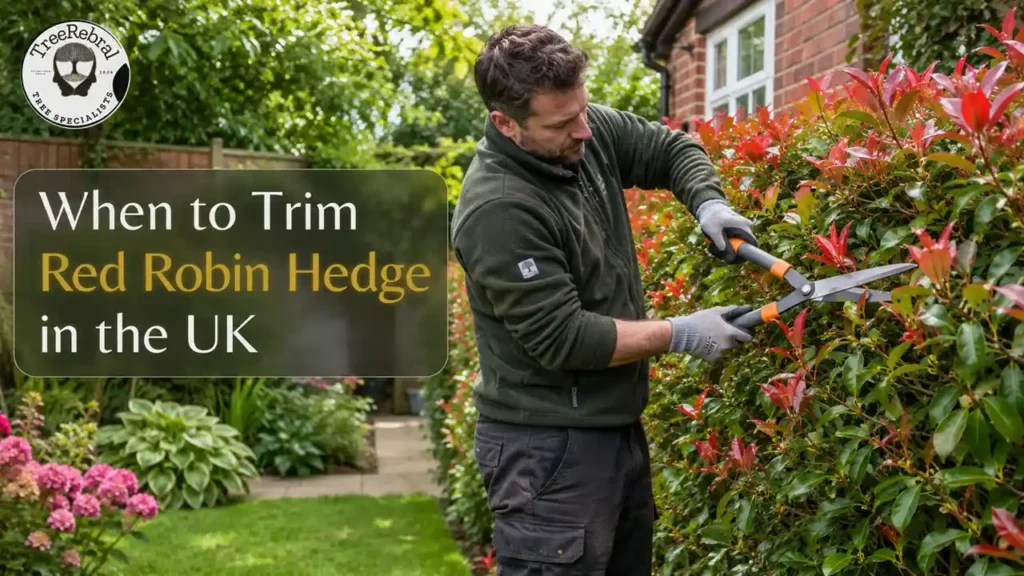
The best time to trim a Red Robin hedge in the UK is in spring and summer. The question of when to trim red robin hedge growth is best answered with a short season, not a single date. Established hedges can usually take two or three light trims in the growing season. Stop routine cutting after mid-August, when soft growth can suffer frost damage. Check for active bird nests before every cut.
This guide covers timing, frequency, technique, and renovation, following Royal Horticultural Society (RHS) guidance for Photinia × fraseri ‘Red Robin’, a member of the Rosaceae family.
When to Trim Red Robin Hedge in Spring and Summer
Spring is the main cutting season. A first light trim in late March or April prompts a second flush as the first red leaves fade. A further light trim in June prompts another. The RHS advises up to three trims a year.
The calendar matters more than the number of cuts. Judging when to trim red robin hedge growth by the season keeps new shoots inside the period when they can harden before cold weather. Growth is vigorous, up to 30cm a year.
Red Robin Hedge Trimming Calendar for the UK
The table follows RHS timing. Spring and summer are the working season.
| Season | Recommendation | Main Reason |
| Spring | Recommended | Encourages fresh growth |
| Early summer | Recommended | Controls growth, promotes branching |
| Mid-summer | Light trim only | Maintains the profile |
| After mid-August | Generally avoid | Fresh growth may suffer frost |
| Autumn | Avoid routine trimming | Late regrowth may not harden |
| Winter | Usually avoid routine trimming | Poor timing for fresh growth |
Check for active bird nests before every cut. Dense evergreen cover can hold nests through summer.
How to Trim a Red Robin Hedge Well
Good technique protects shape and colour. Hand tools usually suit a small hedge. For taller or difficult hedges, professional hedge trimming is safer where access, thick stems or a large reduction are involved.
Check the Hedge Before Cutting
Walk both sides first. Look for active nests, damaged stems, and thin or bare sections. Cutting through a nest creates problems a tidy outline cannot undo. Delay work if frost is forecast.
Use Sharp Tools and Make Clean Cuts
The RHS advises secateurs for Photinia, with cuts just above a leaf joint. A trimmer can slice the large leaves and leave brown edges. Keep blades sharp and clean.
Trim the Sides and Top, Keeping a Wider Base
Work the sides first, then level the top. Keep the base slightly wider than the top so light reaches the lower foliage. Step back often.
Take a Little at a Time
Shorten current-season stems by up to 15cm, cutting just above an outward-facing bud. That RHS measure encourages bright young leaves. Removing much healthy foliage leaves a hard outline.
How Often to Trim, and How Much to Take Off
Frequency follows the season. When to trim red robin hedge growth is set by spring and summer. How often to cut depends on formality and vigour. A formal hedge usually needs two or three light trims. An informal hedge often needs less, and young hedges need formative shaping to build a dense framework.
How much to remove depends on the hedge, not on a fixed percentage. Routine trimming shortens current-season growth and keeps the outline. Renovation changes the framework itself. A light cut for one plant can be severe for a stressed one.
Renovation for an Overgrown Red Robin Hedge
Renovation is separate from routine care. For renovation, when to trim red robin hedge growth is decided in spring, once the plant has been assessed. The RHS advises that most cultivars may be pruned hard in spring to regenerate, by cutting back to a low framework and thinning congested regrowth.
Stage large work, starting with one side. The difference between routine trimming and a substantial change in size is explained in the guide to hedge reduction vs hedge trimming. Unlike Leylandii, which does not reliably regrow from old brown wood, a healthy Photinia can often regenerate, but regrowth from completely bare wood should never be promised.
Why Trimming Brings Back the Red Colour
Only new growth shows the bright red colour. Each leaf starts red and matures to glossy green. Shortening a stem prompts lateral shoots, and those fresh shoots carry the red flush.
Sunlight helps the colour show well. A shaded hedge grows leggier, with less red. Regular light trimming builds density as new branching fills gaps. Trimming removes flower buds, so a closely trimmed hedge flowers less.
Mistakes That Weaken a Red Robin Hedge
Most damage comes from timing or excess, not from a single wrong cut. The errors below are easy to avoid, once the season is respected.
- Trimming after mid-August prompts soft growth that frosts can damage.
- Cutting hard just before a forecast frost exposes fresh wounds to cold.
- Removing too much healthy foliage in one visit leaves the hedge thin.
- Using blunt blades, or a trimmer across the spring flush, slices leaves and leaves brown edges.
- Thin or congested sections need thinning, not another surface trim.
- Treating Red Robin like Leylandii leads to cuts into old wood, as if every evergreen behaved the same way.
Two checks belong before every cut. Look for active nests, and postpone work until a nest is no longer in use, because damaging an active nest is an offence under the Wildlife and Countryside Act 1981. Check for stress from drought, waterlogging or leaf spot, and trim lightly or wait.
When a Professional Trim Makes Sense
Some hedges are beyond a comfortable home trim. Height, thickness, awkward access and a large renovation raise the risk of an uneven result. TreeRebral provides hedge trimming and cutting across Poole, Bournemouth, Christchurch and Dorset. A professional visit suits tall or overgrown hedges.
An assessment helps where the hedge is bare, patchy or showing persistent leaf spot. The right response may be staged renovation or lighter maintenance, rather than a single heavy cut. Early help leaves more growth to work with.
Red Robin Hedge Trimming FAQs
The answers below cover the questions homeowners ask most often.
Can You Trim a Red Robin Hedge in September?
Routine trimming should stop after mid-August, so September is not a normal cutting month. The guidance on when to trim red robin hedge growth is spring and summer cuts, then a pause while new growth hardens. At most, a very light tidy may be considered. Heavy cutting should wait until spring.
Will a Red Robin Hedge Grow Back After Hard Cutting?
A healthy, established hedge often can, when hard pruning is done in spring and congested regrowth is thinned afterwards. The RHS advises that most cultivars may be pruned hard in spring to regenerate if necessary. Recovery is not guaranteed for a weak plant.
Should You Trim Red Robin When It Is Flowering?
Trimming in late spring removes flower buds, so the hedge flowers less. The RHS notes flowers appear in spring if the shrub is left unpruned. If flowers matter, trim after flowering.
Can You Trim a Red Robin Hedge in Hot Weather?
Avoid trimming in prolonged hot, dry weather or strong direct sun. Soft new growth and fresh cuts cope poorly with heat and drought. Wait for cooler weather.
How Do You Trim Red Robin Without Damaging the Leaves?
Use sharp secateurs, cutting just above a leaf joint or an outward-facing bud. The RHS advises secateurs because a trimmer slices the large leaves and leaves brown edges. Keep blades clean and work in dry conditions.
A Simple Rule for Red Robin Timing
Trim lightly in spring and summer, stop after mid-August, and check for nests before every cut. That sequence answers when to trim red robin hedge growth for most UK gardens. Renovation stays separate: a spring decision for healthy, overgrown hedges.
For tall, overgrown or difficult hedges across Dorset, TreeRebral can assess the hedge and plan the work around the season. The RHS Photinia growing guide sets out the timing and renovation guidance used here.