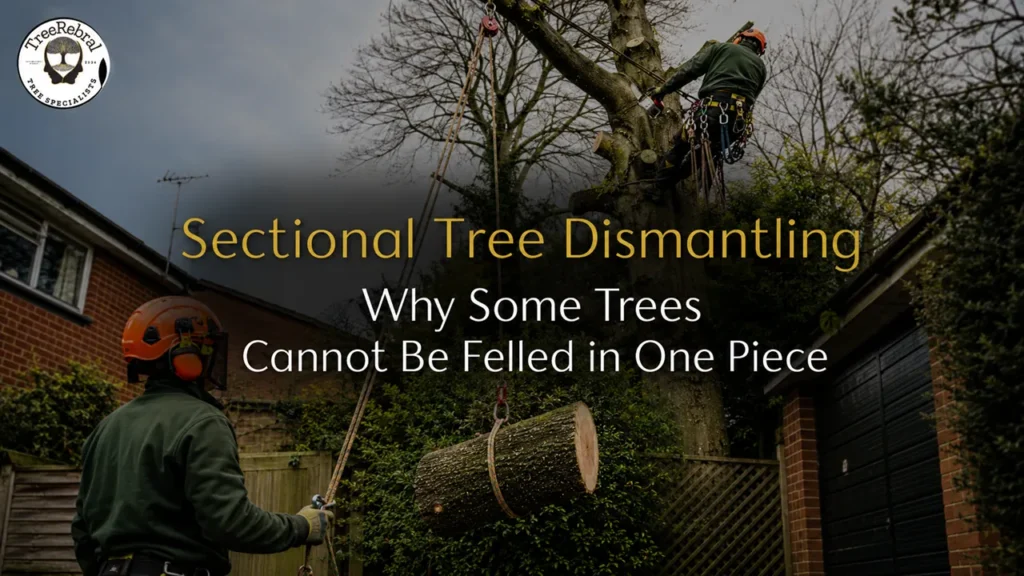
Sectional tree dismantling is used when a tree cannot be allowed to fall in one piece because houses, roads, gardens, cables or other obstacles restrict the available space. A tree surgeon progressively removes the crown and trunk in controlled sections, allowing each part to be dropped or lowered into an appropriate area.
This method may be needed for a large tree in a small garden, a damaged tree beside a building or a tree overhanging neighbouring land. TreeRebral provides professional tree surgery across Poole, Bournemouth and Christchurch, with the removal method chosen after assessing the tree and its surroundings.
What Does Dismantling a Tree in Sections Mean?
A sectional dismantle removes the tree from the top down rather than cutting it at the base and directing the whole structure towards the ground.
Smaller branches are normally removed first. Larger limbs and sections of the main stem then follow until only a short trunk or stump remains. The pieces may be allowed to fall into a controlled area or lowered using ropes where the space below must be protected.
This is a complete tree-removal method. It should not be confused with crown reduction, which retains the tree while reducing the size or spread of its canopy.
Straight Felling Compared with Sectional Dismantling
Straight felling requires enough open ground for the tree to fall largely in one piece. Sectional removal needs less continuous space because the tree is reduced progressively.
| Factor | Straight Felling | Sectional Dismantling |
| Removal method | Tree falls largely in one piece | Crown and trunk are removed progressively |
| Space required | Large, clear drop zone | Suitable for more restricted sites |
| Typical setting | Open land | Gardens, roadsides and built-up areas |
| Nearby obstacles | Relatively few | Buildings, fences, vehicles or utilities |
| Climbing | Not always required | Often used where the tree is suitable |
| Rigging | Not always required | Used when pieces cannot fall freely |
| Ground control | Manages the whole-tree fall | Manages individual branches and sections |
| Complexity | Usually lower | Generally requires more detailed planning |
| Best option every time | No | No |
Neither method is automatically safer for every tree. The right approach depends on its condition, natural lean, available space, access and what could be damaged if the removal does not proceed as planned.
When Is Sectional Tree Dismantling Needed?
The method is normally considered when the tree cannot enter a suitable drop zone without affecting people, property or infrastructure.
Trees Close to Houses and Garden Structures
A tree beside a house, conservatory, garage or garden room may have branches extending over roofs, glazing or boundary walls. Removing smaller pieces gives the team greater control over where the timber reaches the ground.
This can also protect sheds, greenhouses, fences and landscaped areas that sit beneath the canopy.
Trees in Small or Enclosed Gardens
Terraced properties and enclosed rear gardens may offer little room for conventional felling. Access can also be limited to a narrow side passage or route through the property.
In these situations, section sizes and timber-handling arrangements need to reflect both the available drop zone and how material will leave the site.
Trees Beside Roads and Footpaths
Trees close to a public highway or pavement require control of the work area as well as the tree itself. Pedestrians, vehicles and neighbouring access can affect when and how individual sections are removed.
Traffic or pedestrian management may be required according to the location and work plan.
Trees Near Overhead Services
Work near overhead power lines needs specialist planning because electrical injury can occur through direct contact or flashover without physical contact. The relevant network operator may need to be involved before work begins.
Homeowners should not attempt to assess or cut trees close to electrical infrastructure themselves.
Dead, Damaged or Unstable Trees
A weakened tree may not provide reliable climbing or rigging anchor points. Decay, a split stem or root movement can therefore change the planned access method and the size of each removable section.
The approach may involve climbing, machinery or another controlled method. TreeRebral’s guide to managing an old or weakened tree explains why visible damage must be considered in context.
How Does the Removal Process Usually Progress?
The exact programme changes from one site to another, but a controlled tree take-down normally follows a logical sequence.
- Assess the tree and site: The tree’s structure, condition, access and surrounding targets are reviewed.
- Complete pre-work checks: Protected-tree status, wildlife, overhead services and neighbouring access are considered.
- Choose the access method: The plan may involve climbing or suitable mechanical access, depending on the tree and site.
- Establish the work zone: The team controls the area below and agrees communication between the person aloft and the ground crew.
- Remove the crown: Smaller branches are taken first, followed by larger limbs in manageable sections.
- Reduce the main stem: The remaining trunk is cut into sections that can be controlled within the available space.
- Process the material: Branches may be chipped, with larger timber cut, stacked or removed according to the quotation.
HSE treats sectional felling as aerial tree work and states that climbing and lifting operations require suitable competence, planning and supervision.
When Are Ropes and Rigging Used?
Rigging is used when a branch or trunk section cannot be allowed to fall freely. A rope system can control its movement and lower it towards a selected landing area.
For example, a heavy limb above a conservatory may need controlled lowering rather than a direct drop. The tree surgeon also has to consider the strength of the proposed rigging points and the forces transferred into the tree.
Not every removed piece needs a rope. Where a clear area exists below, smaller material may be dropped directly under controlled conditions. The work plan decides which sections need lowering rather than treating one technique as suitable for the entire tree.
Is a Crane or MEWP Always Required?
No. Many trees are dismantled by a climbing tree surgeon working with a ground team. A mobile elevating work platform, commonly called a MEWP, may be considered where climbing is unsuitable or access from a platform is more practical.
A crane may assist with some large or highly restricted removals, but it is not automatically required because a tree is tall. Access, ground conditions, tree condition, available working space and the weight of the planned sections all influence equipment selection.
The presence of machinery does not remove the need for detailed planning. Every section still needs a controlled route away from the tree and through the site.
What Happens to the Branches, Timber and Stump?
Branches are often processed through a wood chipper, while larger timber may be cut into manageable lengths. The quotation should state whether wood, logs and chippings will be removed or left for the property owner.
The Stump Usually Remains
Dismantling removes the crown and trunk above ground, but it does not normally remove the root system. A low stump is usually left unless another service has been agreed.
Where the area needs clearing for landscaping or access, removing the remaining stump can be quoted separately.
Do Protected Trees Require Permission?
A Tree Preservation Order can prevent a tree from being cut down or otherwise worked on without consent from the local planning authority. Trees within conservation areas may also require written notification before work starts.
BCP Council states that permission is required for work to TPO-protected trees and that unauthorised pruning or felling can be a criminal offence. Its protected-tree guidance also explains the local process for Bournemouth, Christchurch and Poole.
Wildlife checks remain relevant even where removal has been approved. An active wild-bird nest must not be damaged while it is being built or used.
Why Does an On-Site Assessment Matter?
Photographs can show the tree’s approximate size and position, but they may not reveal decay, weak branch unions, the condition of the root plate or practical access limitations.
TreeRebral assesses the tree’s condition, canopy spread, natural lean, available drop zone and nearby property before recommending straight felling or controlled removal. The assessment also helps define section sizes, ground protection and whether specialist access may be required.
This prevents the method from being chosen solely because the tree looks large or stands close to a building.
Questions About Controlled Tree Removal
Is Sectional Tree Dismantling the Same as Tree Felling?
It is a form of tree felling, but the tree is removed progressively rather than falling in one piece. Straight felling requires a suitable open drop zone.
Can a Tree Be Dismantled Close to a House?
Yes, where an appropriate work plan can control branches and trunk sections. The site must still be assessed for access, fragile surfaces and areas that need protection.
Does Every Dismantling Job Require Rigging?
No. Rigging is used where pieces cannot fall freely. Other sections may be dropped into a controlled area when the conditions permit.
Can a Dead Tree Be Climbed?
Not always. Decay or structural weakness may make climbing or anchor points unsuitable. The assessment may identify another access or removal method.
Is a Crane Needed for Every Large Tree?
No. Tree size is only one factor. Access, structural condition, obstacles and available working space determine whether a crane, MEWP or climbing system is appropriate.
Does the Service Include Stump Grinding?
Not automatically. Tree dismantling usually leaves a stump unless grinding or another stump treatment is included in the quotation.
How Long Does a Sectional Take-Down Require?
There is no universal duration. Tree size, condition, site access, rigging requirements and the amount of material being removed all affect the programme.
Choose the Removal Method After Inspecting the Site
Sectional tree dismantling is most useful where a whole-tree fall cannot be controlled within the available space. It allows the crown and trunk to be reduced progressively around buildings, roads, gardens and other obstacles.
TreeRebral can assess large, damaged or awkwardly positioned trees across Poole, Bournemouth and Christchurch. The inspection determines whether straight felling is practical or whether a controlled sectional removal is the more appropriate option.