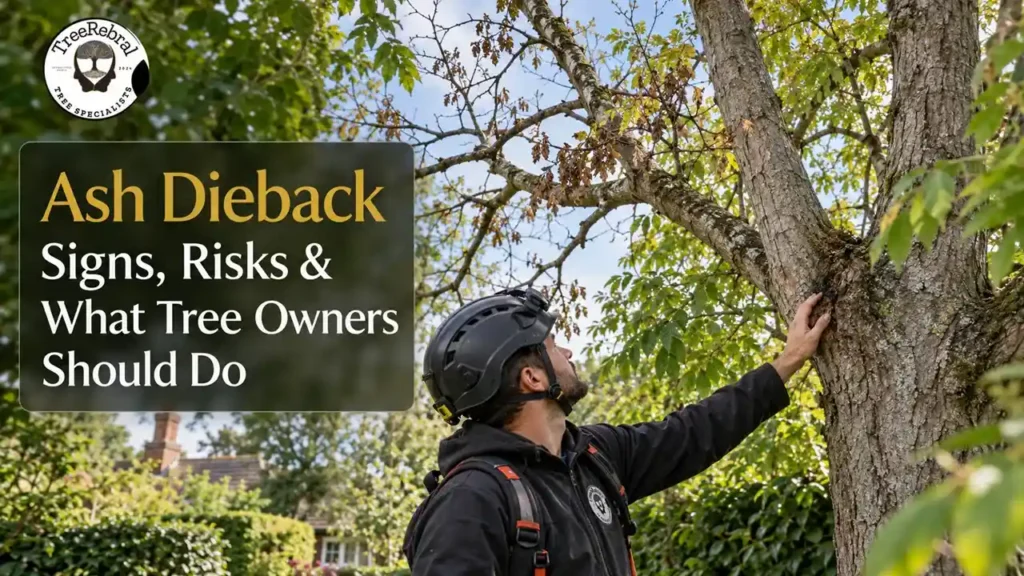
Ash dieback is a fungal disease caused by Hymenoscyphus fraxineus that affects ash trees across the UK. Common signs include crown dieback, dead shoots, leaf loss, bark lesions and epicormic growth. An infected tree does not automatically need removing, but trees with extensive decline, deadwood or deterioration should be assessed where they could affect people, buildings, roads or frequently used areas.
What Is Ash Dieback?
Ash dieback is a highly destructive ash tree disease, especially of the UK’s native common ash, Fraxinus excelsior. The fungus blocks water and nutrient movement within the tree, causing bark lesions, leaf loss and crown dieback. First confirmed in the UK in 2012, it is now present in most parts of the country and is also known as Chalara, after the fungus’s former name.
The ash dieback fungus reproduces on fallen ash leaf stalks, releasing spores between June and September, and wind carries those spores over tens of miles.
What Are the Signs of Ash Dieback?
The main ash dieback symptoms are clearest in mid to late summer, when a healthy ash should be in full leaf. Judge them together, not singly.
Crown Dieback and Leaf Loss
Leaves blacken and wilt from mid-summer, and many are shed early. Dieback starts at the crown edges and shoot tips, leaving a thin, sparse canopy. A healthy ash is in full leaf by mid-June, so a crown that stays thin through summer deserves attention.
Bark and Stem Lesions
Dark lesions form in the bark, often diamond-shaped, centred where branches join the trunk or each other. They can spread up and down the stem and eventually girdle it, cutting off water and nutrients. Unlike leaf symptoms, lesions are visible at any time of year.
Epicormic Growth
As the crown declines, the tree often produces clusters of shoots from dormant buds on trunk and branches. This bushy growth is a stress response, not recovery.
Dead Branches and Canopy Decline
Dead shoots, twigs and branches accumulate in the crown, and the canopy thins over successive seasons. Dead ash wood becomes brittle, so dead branches are a safety consideration too.
Can You Identify Ash Dieback From Symptoms Alone?
Ash dieback identification from symptoms alone is not reliable. Ash is one of the last trees to flush in spring, so a bare ash in April or May is not necessarily diseased. In autumn, natural leaf colour and retained dark keys can be mistaken for blackened leaves. Drought, frost and other fungal problems can also cause wilting, leaf loss and dieback, and basal lesions can weaken the trunk with few crown symptoms.
These symptoms may indicate ash dieback, but a professional tree surgery assessment can confirm the condition and rule out other causes. Mountain ash, or rowan, is not a true ash and is not susceptible, so check the tree is actually an ash first: opposite buds, black winter buds and compound leaves are the usual markers.
Does Ash Dieback Kill Every Ash Tree?
No. Young and coppiced ash can be killed quite quickly, but older trees often decline gradually.
A small proportion show greater tolerance, and some infected ash trees survive and may recover to good health. Tolerance cannot be predicted for an individual tree, so a lightly affected tree still needs watching over time.
Is an Ash Tree With Dieback Dangerous?
Disease presence alone does not settle the question: risk depends on the tree and on what stands beneath or beside it.
| Factor | Why It Matters |
| Deadwood and brittleness | Dead ash wood can fail without warning. |
| Basal lesions and roots | Can undermine trunk stability. |
| Location and targets | Raises the consequences of failure. |
A dying ash tree beside a footpath is a different proposition from a lightly affected ash in open ground.
Does Every Ash Tree With Dieback Need Removing?
No. Not every ash tree with ash dieback should automatically be felled. Official guidance carries a general presumption against felling living ash, except for public safety or timber production.
Possible outcomes include monitoring, retaining the tree, removing deadwood, managing what stands nearby, further assessment, staged intervention, or removal where structural condition creates unacceptable risk. Removal is a management decision based on condition and risk, not the automatic response to a diagnosis.
Can Ash Dieback Be Treated?
There is currently no simple ash dieback treatment available to homeowners. Pruning does not cure the infection, and cutting out dead branches manages safety rather than removing the fungus.
Suppressive fungicide treatment is sometimes discussed for exceptional high-value trees, but it needs repeated application and is impractical for ordinary garden ash. Ash dieback management therefore focuses on monitoring, safety risks, retaining tolerant trees, and removing trees only where condition and risk justify it.
When Should an Ash Tree Be Professionally Assessed?
Arrange an assessment promptly if you notice any of the following.
- Crown dieback is spreading year on year.
- Large dead branches overhang a road, footpath, driveway or garden.
- Lesions are visible near the base of the trunk.
- The tree leans, root ground lifts, or fungal brackets appear at the base.
- The tree stands close to buildings, boundaries or places used daily.
- You are unsure whether it is an ash, or dieback is the real cause.
A professional tree safety inspection records condition, defects and risk, so decisions rest on evidence rather than guesswork. TreeRebral provides these assessments across Poole, Bournemouth and Christchurch.
Who Is Responsible for Managing an Ash Tree With Dieback?
Tree owners and land managers should take reasonable steps to manage foreseeable risks from trees on their land: know your trees, check them, and act on problems that could cause harm near roads, footpaths and buildings.
There is no legal duty to fell an infected tree simply because it is infected, and action is only legally required if a Statutory Plant Health Notice is served. Disease does not remove legal protection: an ash tree can still be covered by a Tree Preservation Order or stand in a conservation area, so check with BCP Council, the planning authority for Poole, Bournemouth and Christchurch, before any work is carried out.
What Should You Do if You Suspect Ash Dieback?
- Note what you can see and when, and photograph leaves, lesions and the whole crown.
- Check for a Tree Preservation Order or conservation area before arranging any work.
- Keep people and vehicles clear of large dead branches until assessment.
- Arrange a professional assessment if the tree is declining, has basal lesions, or stands near people, buildings or roads.
- Follow the advice given, whether monitoring, deadwood removal, staged work or removal, and re-check at least once a year.
Professional Ash Tree Care With TreeRebral
If you are concerned about an ash tree in Poole, Bournemouth, Christchurch or elsewhere in Dorset, TreeRebral can assess its condition, explain whether monitoring, management or removal is right, and carry out agreed work safely.
Our professional tree surgery service covers assessment, management and, where justified, controlled removal of affected ash trees. Full technical detail is in the Forest Research ash dieback guidance.
Frequently Asked Questions
The questions homeowners most often ask about ash dieback in the UK.
What Does Ash Dieback Look Like?
Ash dieback looks like thinning at the crown edges, blackened and wilting leaves shed early, dark diamond-shaped lesions on bark, bushy epicormic shoots, and increasing deadwood. Symptoms are clearest in mid to late summer, when a healthy ash is in full leaf.
Can Ash Dieback Be Treated?
Ash dieback cannot be treated with a simple cure. Pruning manages safety by removing dead branches but does not remove the fungus. Suppressive treatment exists only for exceptional high-value trees, needs repeated application, and is not practical for most homeowners.
Does an Infected Ash Tree Need to Be Removed?
An infected ash tree does not automatically need to be removed. Official guidance favours retaining living ash where it is safe to do so. Removal becomes appropriate only where condition, deadwood or basal lesions create a risk monitoring and management cannot acceptably control.
Can Ash Dieback Spread to Other Trees?
Ash dieback can spread to other ash trees through wind-borne spores released from fallen leaf stalks between June and September, and over longer distances through moved infected ash plants. It does not spread to non-ash species, and mountain ash is not susceptible.