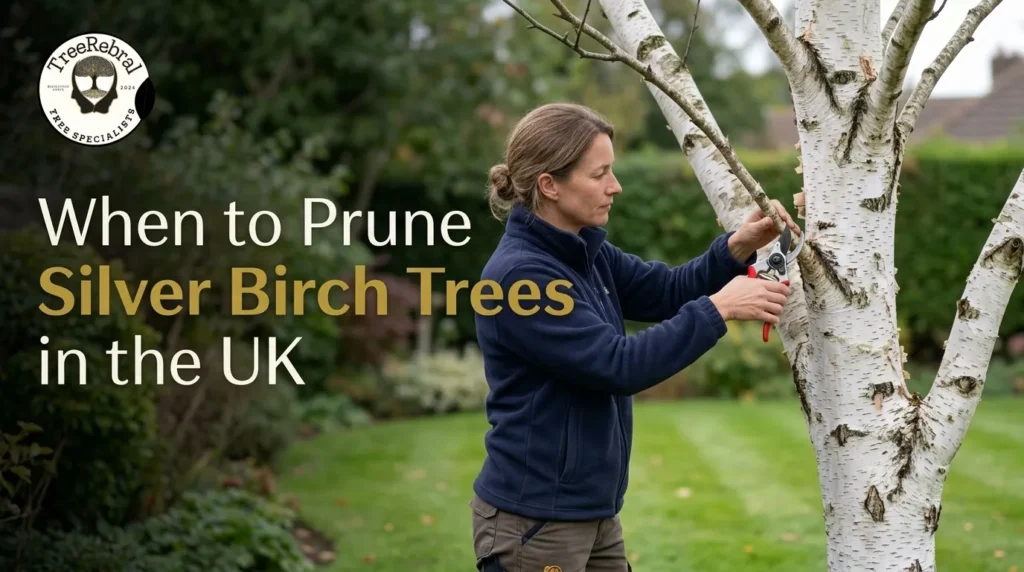
The best answer to when to prune silver birch is usually late summer through to early winter, before sap begins rising strongly. For established trees, early winter once the tree is dormant is a particularly useful window for necessary pruning.
Silver birch, or Betula pendula, generally needs relatively little routine pruning. Avoid unnecessary cutting, especially from late winter into spring when pruning wounds can bleed sap heavily. This bleeding often looks alarming but does not automatically mean the tree has been seriously damaged.
When to Prune Silver Birch: Start with the Season
Unlike many garden trees, silver birch is particularly sensitive to pruning timing because its sap starts moving early in the year.
A practical UK pruning calendar looks like this:
| Time of Year | General Approach |
| Late summer | Suitable for necessary selective pruning |
| Autumn | Generally suitable where pruning is needed |
| Early winter | Good period for routine work once the tree is dormant |
| Mid to late winter | Increasing risk of sap flow as the season progresses |
| Spring | Avoid routine pruning where possible |
| Early summer | Usually unnecessary for routine pruning |
The dates should not be treated as rigid calendar deadlines. Weather, tree condition and the type of work still matter.
RHS guidance advises avoiding pruning birch where possible, but where work is necessary it identifies late summer through to before mid-winter as the useful period. It also notes that established trees can have damaged or diseased branches dealt with once dormant in early winter.
Why Does Silver Birch Bleed Sap After Pruning?
Silver birch is one of several trees known for noticeable sap bleeding from pruning wounds.
Sap carries water, sugars, nutrients and other compounds through the tree. During late winter and early spring, pressure within the tree’s vascular system increases as growth resumes. A fresh pruning wound made during this period can release considerable amounts of sap.
That is why understanding when to prune silver birch matters more than simply waiting until the tree has lost its leaves.
Heavy sap flow can look serious, but RHS guidance says bleeding from pruning cuts is usually not harmful and generally stops naturally. The tree should not normally be bandaged, wrapped or painted in an attempt to stop it.
The better approach is to avoid creating unnecessary wounds during periods when sap pressure is high.
Does an Established Silver Birch Actually Need Pruning?
Usually, not very much.
Silver birch naturally develops an open, graceful crown, and established trees generally do not benefit from being routinely cut back simply because another year has passed. RHS guidance specifically states that established birches do not require regular pruning.
Pruning should have a clear reason. That may include damaged branches, crossing growth, a structural issue, necessary clearance or selected deadwood.
A healthy mature tree should not automatically be reduced because it has become tall. Size alone does not show that a tree has become unsafe or that reducing its crown is necessary.
Where the reason for pruning is unclear, a professional tree assessment can help separate normal mature growth from defects that genuinely need management.
Young and Mature Silver Birches Need Different Thinking
Age changes the purpose of the pruning.
Young Trees Benefit from Small Structural Corrections
With a young silver birch, formative pruning is about developing a useful branch framework while cuts are still relatively small.
Poorly positioned, crossing or competing growth may sometimes be corrected before it develops into larger branches. Lower laterals can also be managed gradually where a clear stem is required.
The aim is not to repeatedly shape the young tree. It is to make limited corrections that reduce the need for more disruptive cuts later.
Mature Trees Usually Need Restraint
A mature silver birch has already established its natural form and branch structure.
Pruning is therefore more likely to focus on specific problems such as damaged wood, clearance or individual structural concerns rather than reshaping the complete canopy.
This difference is important. Applying a young-tree formative approach to a mature tree can create unnecessarily large wounds and remove more healthy leaf-bearing growth than is justified.
How Should a Silver Birch Be Pruned?
For small, accessible pruning, the principle is to remove only what has a clear reason to come off and preserve the tree’s natural crown.
A sensible sequence is:
- Decide why the branch needs removing. Do not start by deciding how much of the tree you want to cut away.
- Identify the branch structure. Look at where the branch joins its parent stem and whether other branches depend on it for the shape of the crown.
- Make clean, appropriate cuts. Cuts should respect the natural branch attachment rather than leaving long unnecessary stubs or cutting flush into the parent stem.
- Stop once the objective has been achieved. More pruning is not automatically better pruning.
The Arboricultural Association advises retaining the branch collar and avoiding unnecessary large pruning wounds. It also warns that removing excessive leaf-bearing material can reduce tree vitality.
Large branches, work at height and complex canopy pruning are better handled through professional tree pruning services rather than treated as routine garden trimming.
Is the Problem Height, Lower Branches or Canopy Spread?
Homeowners often describe a silver birch as simply “too big”, but different problems require different pruning approaches.
Lower Branches Are Causing a Clearance Problem
Where lower branches interfere with access, a driveway or another usable space, selective crown lifting may sometimes create the required clearance.
This means managing selected lower branches rather than shortening the complete crown.
The Crown Has Outgrown the Available Space
Where height or spread genuinely needs managing, crown reduction may sometimes be considered after assessment.
A proper reduction selectively shortens parts of the crown while maintaining a recognisable natural framework. It should not be confused with cutting every branch back to the same arbitrary level.
Homeowners dealing with a mature tree that has become difficult for its location can read TreeRebral’s guide to whether crown reduction is appropriate.
The Tree Is Simply Tall
Height on its own is not a reason to prune.
Silver birch is naturally a tree rather than a compact garden shrub. Trying to maintain a mature specimen at an artificially low height can lead to repeated large cuts and an unnatural crown.
The management objective should therefore be identified before deciding how much, if anything, should be removed.
Should You Top a Silver Birch Tree?
Routine topping is not an appropriate substitute for selective pruning.
Topping generally involves cutting major branches or stems back without maintaining a suitable natural branch framework. It can create large wounds and alter the structure of the canopy substantially.
Crown reduction is different. Where justified, it is planned around branch structure and suitable growth points rather than simply cutting the top off the tree.
This distinction matters particularly with silver birch because hard pruning is not recommended.
If the tree has become genuinely unsuitable for its available space, professional assessment is more useful than trying to solve the problem through increasingly severe cutting.
Common Silver Birch Pruning Mistakes
Most avoidable problems come from either pruning at the wrong time or removing more of the tree than necessary.
Waiting Until Late Winter
A leafless tree may appear ready for pruning, but silver birch sap can begin rising before obvious spring growth starts. Late winter is therefore not automatically the ideal dormant-tree pruning period.
Removing Healthy Growth Without a Clear Objective
A sparse, natural birch crown does not need to be heavily thinned simply to make it look maintained.
Every live branch contributes foliage to the tree. Removing unnecessary healthy growth reduces the amount of leaf area available for photosynthesis.
Leaving Poor Cuts
Long stubs and damaging flush cuts can both create unnecessary problems. The branch collar and natural attachment should guide appropriate branch removal.
Trying to Reshape the Entire Tree at Once
Overgrown or previously neglected trees need assessment rather than aggressive corrective pruning in a single visit.
Knowing when to prune silver birch is only half of the decision. Knowing how little intervention is actually required is equally important.
Do You Need Permission Before Pruning a Silver Birch?
Not simply because the tree is a silver birch.
However, any species of tree can potentially be protected by a Tree Preservation Order, and qualifying trees within conservation areas can also be subject to controls.
For properties in Bournemouth, Christchurch and Poole, BCP Council states that permission is required before work to a tree protected by a TPO. A qualifying tree within a conservation area that does not have a TPO normally requires six weeks’ written notification before work begins.
This means planning status should be checked before significant pruning rather than after the work has already started.
TreeRebral also has a dedicated guide explaining work on protected trees.
Remember Wildlife Before Choosing the Pruning Date
Seasonal timing is not only about sap flow.
Trees can contain active bird nests, and those nests remain legally protected while they are being built or used. There is not a blanket rule making all domestic tree pruning illegal throughout a fixed set of months, but work must not damage or destroy an active nest.
BCP Council identifies March to August as the main local bird nesting period while also making clear that active nests are protected throughout the year. BCP
This is another reason the actual tree should be checked before pruning begins.
When Should a Tree Surgeon Prune a Silver Birch?
Professional input becomes more useful as the size, height or complexity of the proposed work increases.
That includes large mature branches, substantial crown management, branches above buildings or public areas, suspected structural defects, storm damage and work where the correct pruning specification is uncertain.
TreeRebral provides tree surgery and pruning across Poole, Bournemouth and Christchurch. The appropriate work can be based on the individual tree rather than automatically reducing the canopy because it appears large.
Where the timing itself is part of the question, TreeRebral’s guide to when professional tree work should be carried out provides broader seasonal context for other types of tree work.
Silver Birch Pruning FAQs
Can I Prune Silver Birch in Spring?
Routine spring pruning is best avoided where possible because birch sap flow is strong at this time and fresh cuts may bleed considerably.
Can Silver Birch Be Pruned in Summer?
Yes, necessary pruning can be carried out from later summer as sap-flow concerns reduce. The scope of work and presence of active bird nests still need consideration.
Why Is My Silver Birch Bleeding Sap?
Sap can flow from fresh pruning wounds when internal sap pressure is high, particularly from late winter into spring. It can look dramatic but does not automatically mean the tree is seriously damaged.
How Often Should Silver Birch Be Pruned?
There is no useful fixed annual schedule. Established silver birches generally need little routine pruning, so work should respond to actual defects, clearance needs or structural objectives.
Can You Reduce the Height of a Silver Birch?
Sometimes, but height reduction should be professionally specified and proportionate to the tree. It should not be confused with topping.
Can Lower Branches Be Removed?
Selected lower branches may be removed where crown lifting is appropriate, particularly on younger trees or where genuine clearance is required. The effect on the tree’s structure should be considered before larger limbs are removed.
Can Dead Branches Be Removed at Any Time?
Necessary safety work may sometimes need to take priority over the ideal seasonal window. For non-urgent work, pruning during the suitable birch pruning period reduces avoidable sap bleeding.
Should a Young Silver Birch Be Pruned?
Young trees may benefit from limited formative pruning to correct poorly positioned or competing growth. They do not normally need routine heavy trimming.
Check Authoritative UK Birch Pruning Guidance
For further guidance on when to prune silver birch and other birches, the RHS guidance on growing and pruning birch trees explains why established birches need little regular pruning and why early winter is preferable to late-winter cutting when work is necessary.
The RHS also advises against hard pruning and explains that noticeable sap bleeding generally does not cause serious long-term harm.
Prune for a Reason, Not Just Because the Tree Is Large
The key to when to prune silver birch is combining the right season with a clear reason for carrying out the work. Late summer through early winter provides the most useful general window, while late winter and spring are best avoided for routine pruning because of strong sap flow.
Young trees may benefit from small formative corrections, while mature silver birches usually need a lighter approach focused on specific defects, clearance or carefully planned crown management.
TreeRebral provides professional pruning and tree surgery for homeowners across Poole, Bournemouth, Christchurch and wider Dorset where a silver birch is too large or complex to manage safely from ground level, or where the right pruning approach needs assessment before work begins.