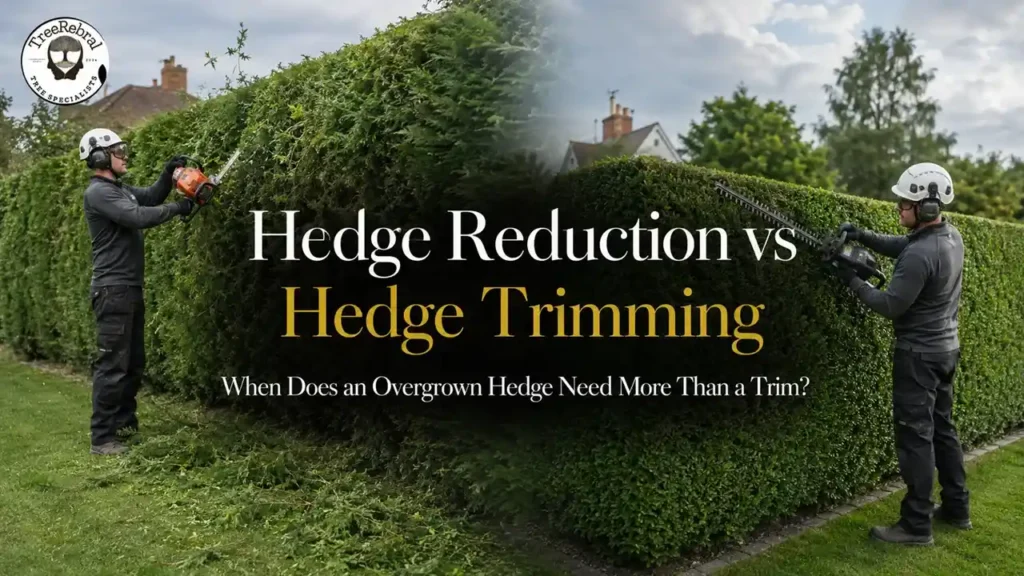
The difference between hedge reduction vs hedge trimming is the amount and purpose of the work. Trimming removes relatively light growth to maintain an existing height, width and shape. Reduction removes more established growth to make an oversized hedge meaningfully shorter, narrower or easier to manage.
If a hedge is only showing fresh seasonal growth, trimming may be enough. If it has been neglected, blocks access or has grown well beyond its intended dimensions, reduction may be the more suitable approach. The species and condition still determine how far it can safely be cut.
Is the Hedge Still Close to the Size You Actually Want?
The quickest way to separate maintenance from reduction is to imagine the hedge after a normal surface trim.
- Still the Right Size:
If removing the fresh outer growth would leave the hedge at roughly the desired height and width, routine trimming is doing the job it was designed to do. - Still Far Too Tall:
If trimming the green surface would leave a hedge several growth seasons above the intended level, the problem is no longer just new growth. - Still Taking Too Much Space:
A hedge may have an acceptable height but have expanded deeply into a path, driveway or garden. Restoring usable space may require width reduction rather than another light cut.
The key is the finished dimension, not how untidy the surface currently looks.
Hedge Reduction vs Hedge Trimming in One View
| Factor | Hedge Trimming | Hedge Reduction |
| Main Purpose | Maintain the current form | Change the overall dimensions |
| Growth Removed | Mainly recent outer growth | More established stems and branches |
| Height Change | Usually limited | Can be substantial where appropriate |
| Width Change | Maintains an existing face | Brings an oversized side back |
| Typical Hedge | Already close to target size | Neglected or significantly oversized |
| Recovery | Usually limited visible disruption | May need time to fill and rebalance |
| Species Sensitivity | Important | Critical |
| Future Work | Continued routine maintenance | Followed by a new maintenance cycle |
A reduction should create a realistic future cutting line. Removing large amounts of growth without deciding how the hedge will be maintained afterwards simply delays the same problem.
When Is Routine Trimming Enough?
Routine trimming suits a hedge whose main framework is already where you want it. The work controls fresh shoots, keeps a consistent face and prevents yearly growth from gradually increasing the hedge’s dimensions.
A formal hedge may need its top and sides brought back to the established line. An informal hedge may only need selected growth shortened while retaining a softer shape.
TreeRebral provides professional hedge care across Poole, Bournemouth and Christchurch for hedges that need routine shaping as well as more substantial management.
Trimming becomes less useful when the desired cutting line sits well inside older, established growth.
When Has an Overgrown Hedge Moved into Reduction Territory?
The Top Is Beyond Safe Routine Reach
A hedge that has become progressively taller can reach a point where maintaining only the newest growth simply preserves an unwanted height. Reduction lowers the main framework so later trimming can take place at a more manageable level.
The Sides Have Taken Over Usable Space
A boundary hedge can gradually widen into a path, driveway or planting area. If the green outer face sits a long way from the intended boundary line, reducing width may be necessary.
Previous Trims Have Maintained the Problem
Repeatedly clipping the outside of an oversized hedge can keep it neat without solving the underlying size issue. A substantial reduction resets the dimensions rather than polishing an already unsuitable profile.
This is the practical difference at the centre of hedge reduction vs hedge trimming: one preserves the current framework, while the other deliberately changes it.
Species Can Overrule the Finished Size You Want
A hedge cannot always be cut back to an arbitrary line. Its ability to produce new shoots from older wood matters.
- Beech, Hornbeam, Hawthorn and Holly: Established examples of these hedges can often respond to renovation when healthy, although severe work may be better staged.
- Yew: Yew is unusual among common conifers because it can produce new growth from older wood, making significant renovation possible in situations where other conifers would remain bare.
- Leylandii and Many Other Conifers: These require much greater caution. Most do not regenerate reliably from old brown wood, so taking the side back beyond its green growth can leave a permanent bare face. RHS specifically identifies Leyland cypress, Cupressus and Chamaecyparis among conifers that do not respond well to hard renovation.
TreeRebral’s guide to cutting back Leylandii explains why retaining suitable green growth matters with this type of hedge.
Species identification should come before deciding how much height or width to remove.
Reduction and Renovation Are Not Quite the Same Job
Trimming
Maintains a hedge that is already close to the correct dimensions.
Reduction
Makes a deliberate decrease in height, width or overall volume.
Renovation
Goes further by restoring a hedge that has become neglected, bare, uneven or structurally poor. It may involve heavier or staged pruning rather than one straightforward size change.
A hedge can need reduction without needing full renovation. For example, a healthy laurel that has become too tall may simply need its height reset. An old hedge with bare lower sections, uneven sides and years of uncontrolled growth may require a longer restoration plan.
That distinction prevents every substantial cut from being labelled the same way.
What Should You Expect After a Major Reduction?
The day of the cut is not the end of the job. The new dimensions need time to become a stable, maintainable hedge again.
- The Framework Becomes More Visible: A substantial reduction may temporarily expose woody stems that were hidden behind dense foliage.
- New Growth Begins: Suitable species produce shoots that gradually soften the new outline.
- Uneven Areas Are Rebalanced: Follow-up pruning guides stronger and weaker sections towards a consistent profile.
- A New Cutting Line Is Established: Future trims should return to the new target height and width rather than allowing the hedge to expand again.
- Routine Maintenance Takes Over: Once recovery is established, lighter trimming becomes the main management method.
If a hedge has already suffered excessive cutting, the guide to recovering a damaged hedge explains why recovery depends heavily on species and the amount of viable growth left.
Can You Reduce the Height and Width at the Same Time?
On a Healthy, Tolerant Hedge
It may be possible to reduce both dimensions in one operation when the species, condition and amount of cutting make that reasonable. The new shape still needs enough viable growth to support recovery.
When the Required Change Is Severe
A staged approach may be more appropriate. One side, the top or part of the hedge may be addressed first, allowing the plant to recover before further heavy pruning.
On a Conifer
The limiting factor may be the depth of green growth rather than the size the homeowner wants. A Leylandii with a very wide brown interior cannot simply be narrowed back to the trunk and expected to produce a new green face.
There is therefore no universal safe percentage or cutting depth for every hedge.
When Does a Simple DIY Trim Become a Bigger Job?
Professional assessment becomes particularly useful where the work involves:
- A hedge too tall to manage safely from ground level
- Thick established stems rather than soft seasonal growth
- A substantial decrease in height or width
- Difficult access for cutting and waste removal
- A roadside hedge or restricted visibility
- Buildings, fences or overhead services close to the work
- An unknown hedge species
- An overgrown conifer where green growth must be preserved
- A neglected hedge that may need staged renovation
A smaller hedge that only needs light maintenance may be practical for a competent homeowner. Major reduction is different because one overly deep cut can permanently change some species.
Do Birds or High-Hedge Rules Affect the Work?
Active bird nests need to be checked before substantial hedge cutting. The RHS notes that it is an offence under the Wildlife and Countryside Act 1981 to damage or destroy a wild bird nest while it is being built or used. The main nesting period is commonly spring and summer, but the legal protection relates to active nests rather than a universal calendar ban.
A hedge being over two metres tall also does not automatically make it illegal. The high-hedge complaint framework applies to qualifying lines of evergreen or semi-evergreen trees or shrubs that are over two metres and affect reasonable enjoyment through light or access. The council then considers the circumstances rather than applying a universal two-metre maximum. For the formal criteria, see the government high-hedge guidance.
Questions Homeowners Ask About Overgrown Hedges
Can You Cut an Overgrown Hedge Back by Half?
Sometimes, but not as a universal rule. Species, health, age, the amount of green growth and whether old wood can regenerate all affect how much can be removed.
Will a Reduced Hedge Grow Back?
Most healthy hedges will produce new growth after suitable reduction, but the response varies considerably between species. Many conifers will not replace foliage removed from bare old wood.
Can a Leylandii Grow Back from a Brown Side?
Generally, not. Once a Leylandii side has been cut beyond the green foliage into old brown wood, that area should not be expected to regenerate reliably.
Can an Old Hedge Be Restored?
Often, particularly with species that tolerate renovation. A badly neglected hedge may need staged pruning rather than one severe operation.
Is Hedge Reduction Permanent?
No. The hedge continues growing. Reduction establishes new dimensions that should then be maintained through regular trimming.
Does Reducing a Hedge Make It Thicker?
It can encourage branching and regrowth in suitable species, but the result depends on plant health, species, cutting depth and future care.
Should One Side Be Reduced at a Time?
For substantial renovation, staging the work can sometimes reduce stress and retain more foliage during recovery. The correct sequence depends on the hedge.
Can a Privacy Hedge Be Reduced Without Losing Privacy?
Possibly, but a large reduction can temporarily expose the framework or create gaps. The desired level of screening should be part of the specification before cutting begins.
Set the New Maintenance Line Before Cutting
The most useful way to think about hedge reduction vs hedge trimming is to decide where the hedge should be maintained in future. If it is already close to that line, trimming removes the latest growth. If the intended line sits deep inside an oversized hedge, reduction or renovation may be necessary first.
TreeRebral can assess hedge species, current dimensions, condition and the finished height or width required for properties across Poole, Bournemouth, Christchurch and wider Dorset. The aim is to choose a reduction that the hedge can tolerate and that can realistically be maintained afterwards.