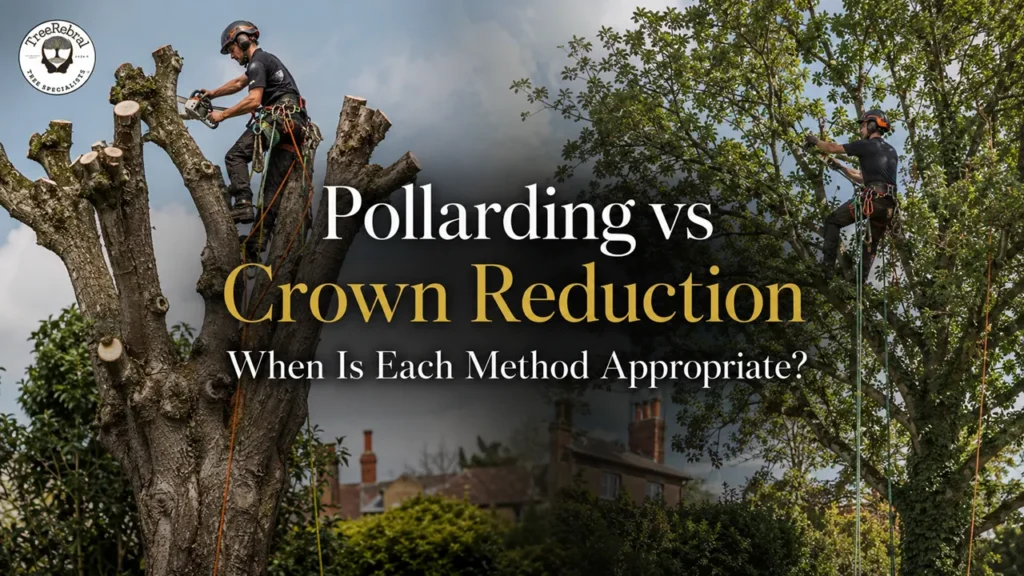
The choice between pollarding vs crown reduction depends on the tree’s previous management, species, maturity, condition and available space. Pollarding creates or maintains a fixed framework that requires repeated cutting. Crown reduction selectively shortens branches to reduce canopy height or spread while retaining a balanced, recognisable tree shape.
TreeRebral provides tree pruning and crown-management services across Poole, Bournemouth, Christchurch and wider Dorset. Before choosing either method, the most important question is whether the tree is already an established pollard or has never been managed that way.
Has the Tree Already Been Pollarded?
An existing pollard and an unpollarded mature tree should not receive the same recommendation.
An Established Pollard
An established pollard has recognisable swollen cutting points, often called pollard heads or knuckles. New shoots grow from these points and are removed as part of a recurring maintenance cycle. Continuing that established system may be appropriate when the tree remains suitable for the work.
A Tree That Has Never Been Pollarded
Starting pollarding for the first time can require large cuts, particularly on a mature tree. The wounds, likely regrowth and future maintenance commitment should be assessed before a new framework is created.
A large tree should not be newly pollarded simply because it casts shade or has outgrown the owner’s preferred shape. Crown reduction or another form of selective pruning may offer a more proportionate response.
Pollarding vs Crown Reduction at a Glance
The two methods can both make a tree smaller, but they create different structures and future responsibilities.
| Comparison Point | Pollarding | Crown Reduction |
| Main Purpose | Maintain a recurring framework at a controlled size | Reduce the height, spread or overall canopy size |
| Cutting Method | New shoots are cut back to established pollard points | Branches are shortened to suitable lateral growth points |
| Tree Shape | Distinct pollard heads with repeated regrowth | A smaller but reasonably natural crown |
| Best Starting Point | Often an existing pollard or a suitable tree managed early | A tree with a suitable branch framework and pruning tolerance |
| Regrowth | Frequently vigorous shoots from fixed cutting points | Regrowth develops throughout the retained crown |
| Future Maintenance | Requires an ongoing cutting cycle | May require later reduction, but not necessarily to fixed points |
| Visual Effect | Formal and clearly managed appearance | Balanced outline that remains recognisable as the original tree |
| Reversibility | Creates a long-term management commitment | Removed branches cannot be restored, but no pollard framework is established |
The RHS describes pollarding as a recurring way to keep suitable trees at a controlled height and identifies London plane and common lime as common examples. Species examples are not automatic approval, because the condition and history of the individual tree still matter.
Why Is Pollarding a Cycle Rather Than a Single Cut?
Pollarding should be considered as a continuing management programme. The first operation is only the beginning.
- A Suitable Framework Is Chosen: The initial structure and cutting points are established on a tree considered capable of tolerating the work.
- New Shoots Develop: Vigorous growth emerges from the pollard points during later growing seasons.
- The Shoots Are Recut: Regrowth is removed according to the management plan before it becomes excessively large or heavy.
- The Framework Is Monitored: Pollard heads, shoot attachments, decay and the condition of the supporting branches are checked over time.
Allowing an established pollard to lapse for many years can leave large branches attached around old cutting points. Removing all that growth in one operation may not always be appropriate, so an overgrown pollard should be assessed before restoration work is specified. The RHS advises seeking arboricultural guidance for neglected pollards because species and branch condition affect the response.
How Does Crown Reduction Change the Canopy?
- Technical Principle
Crown reduction shortens selected branches to appropriate lateral branches or growth points. The specification may address crown height, spread or both. - Plain-English Meaning
The tree becomes smaller, but its main branch framework and natural outline remain visible. The work should not leave random stubs or an abruptly flattened upper crown. - Practical Limitation
Crown reduction does not permanently stop growth. The tree will respond according to its species, vitality, age and the amount removed.
The reduction should be proportionate to the tree’s pruning tolerance. Removing too much living canopy at once can create unnecessary stress and vigorous regrowth, while poor cuts can damage the crown’s future structure.
What Happens After Each Type of Work?
After Pollarding
New shoots generally emerge around the established pollard points. Their attachment and development need monitoring, particularly when growth is vigorous or the cutting cycle has been allowed to lapse.
Over time, repeated cutting creates the swollen pollard heads associated with the method. The owner must be prepared to continue managing the regrowth rather than treating the first operation as a permanent solution.
After Crown Reduction
The retained branches continue to produce new growth and rebuild foliage. The future canopy should develop from the remaining branch framework rather than from a small number of fixed pollard heads.
Further pruning may eventually be needed, but its timing depends on the tree’s response and the reason for the original reduction. A well-planned reduction does not mean that the tree will remain at exactly the same size indefinitely.
Which Tree Situations Point Towards Each Method?
An Established Lime with Recognisable Pollard Heads: Continuing the existing pollarding cycle may maintain the intended framework, provided the heads and supporting structure remain suitable.
A Mature Garden Tree That Has Never Been Pollarded: Selective crown reduction may be more appropriate where a moderate decrease in height or spread can address clearance or space concerns without creating a new pollard structure.
A Neglected Pollard With Large, Heavy Regrowth: The tree needs an assessment before old pollard points are recut. Staged work, selective retention or another management approach may be safer for the tree than removing every branch immediately.
The pollarding vs crown reduction decision should be based on management history as well as the size the owner wants today. The same visual objective can produce very different long-term effects depending on the method used.
Is Pollarding the Same as Tree Topping?
- Misconception: Any tree cut back heavily has been pollarded.
- Correction: Proper pollarding creates or maintains planned cutting points as part of a repeating management system.
- Misconception: Pollarding is simply a severe crown reduction.
- Correction: Crown reduction retains selected lateral branches and a balanced crown. Pollarding establishes a more fixed framework from which recurring shoots grow.
- Misconception: Topping is acceptable when the tree needs a quick reduction.
- Correction: Indiscriminate cuts can leave stubs, large wounds and poorly positioned regrowth. Heavy cutting without a suitable framework or long-term plan should not be presented as pollarding.
The correct terminology matters because it tells the homeowner what structure will remain and what future work will be required.
Which Method Creates More Future Maintenance?
Pollarding normally creates the stronger maintenance commitment because the new shoots must continue to be managed around the established framework.
Before choosing it, consider:
- Whether the species is suitable for recurring cutting
- Whether the tree has already been managed as a pollard
- How vigorously the tree is likely to regrow
- Whether the cutting points remain structurally suitable
- Whether safe access will remain available
- Who will arrange and fund future pruning visits
- What could happen if the cycle is allowed to lapse
Crown reduction also requires monitoring. However, later work is based on the developing canopy rather than automatically cutting new growth back to fixed pollard points.
Does the Season Change Which Method Is Appropriate?
Timing matters, but there is no single pruning month that suits every species and operation. Tree condition, nesting wildlife, sap flow, disease susceptibility and the amount of live growth being removed can all influence the programme.
Pollarding is often carried out during a suitable dormant period, but some species require different timing. Crown reduction should also be scheduled around the individual tree rather than a universal calendar date.
Tree owners can read more about selecting a suitable pruning period before arranging major canopy work.
Could Legal Protection Change the Plan?
Tree Preservation Order: In England, cutting down, topping or lopping a protected tree generally requires written consent from the local planning authority unless a relevant exception applies.
Conservation Area: For qualifying trees in conservation areas, written notice is generally required six weeks before the proposed work unless an exception applies.
BCP Council states that permission is needed before work on a tree protected by a TPO. It also requires six weeks’ written notice for qualifying trees in conservation areas that are not already covered by a TPO. The proposed specification should therefore describe the intended pollarding or reduction clearly.
Legal approval does not determine whether the work is arboriculturally appropriate. It only addresses whether the proposed work may proceed under the applicable tree-protection rules.
How Does a Tree Surgeon Reach the Final Decision?
A site assessment should work through the decision in a logical order:
- Confirm the tree species and likely pruning response.
- Identify whether the tree is an established pollard.
- Assess age, vitality and structural condition.
- Check the trunk, main unions and existing pollard points.
- Review previous pruning and the size of cuts required.
- Define the homeowner’s actual objective.
- Consider buildings, roads, boundaries and available growing space.
- Check TPO or conservation-area restrictions.
- Decide whether the future maintenance commitment is realistic.
- Prepare a clear pruning specification.
TreeRebral can assess whether planned crown management should involve continuation of an existing pollard, selective crown reduction or another proportionate form of pruning.
Neither treatment should be used to conceal serious structural defects. If pruning cannot manage the concern appropriately, a different tree-management decision may need to be considered.
Questions Homeowners Ask About Long-Term Crown Management
Can a Mature Tree Be Pollarded for the First Time?
Sometimes, but the decision requires care. Species, maturity, branch diameter, vitality and the size of the proposed wounds all affect whether starting a new pollarding regime is suitable.
What Is the Main Pollarding vs Crown Reduction Difference?
Pollarding creates or maintains fixed cutting points for repeated pruning. Crown reduction selectively decreases canopy size while retaining a balanced branch framework and more natural shape.
Does Pollarding Permanently Keep a Tree Small?
It can maintain a controlled framework only when the regrowth is cut back as part of an ongoing cycle. Stopping maintenance allows branches to become larger and heavier.
Can an Established Pollard Be Crown Reduced Instead?
Possibly, but changing the management system requires assessment. The condition of the pollard heads, branch attachments and retained framework will affect what can be done.
Is Pollarding Always Harmful?
No. It can be an appropriate long-term system for suitable trees, particularly where a pollard framework is already established. Poorly specified or badly timed work can still cause problems.
Does Crown Reduction Preserve a Natural Shape?
That is normally the aim. Branches are selectively shortened to suitable laterals so the reduced crown remains balanced and recognisable.
Can Crown Reduction Make a Tree Completely Safe?
No pruning method can guarantee complete safety. Crown reduction may reduce loading in suitable situations, but it cannot repair serious root instability, advanced decay or every structural defect.
Can an Overgrown Pollard Be Cut Back to Its Old Heads?
Not automatically. Large regrowth and old pollard points should be assessed before heavy branches are removed, as species and structural condition affect the suitable approach.
Choose the Future Management System, Not Only Today’s Shape
The right pollarding vs crown reduction choice is not simply the method that makes a tree look smaller immediately. Pollarding establishes an ongoing cutting cycle, while crown reduction manages canopy size through selective branch shortening.
TreeRebral provides pollarding, pruning and crown-management services across Poole, Bournemouth, Christchurch and wider Dorset. Homeowners uncertain about the tree’s history, condition or legal status can arrange a tree assessment before committing to major canopy work.