Most homeowners treat their boundary shrubs like a static wall that only needs a haircut when it blocks the driveway. I have seen this costly mistake led to “leggy” stems with no leaves at the base and a literal breeding ground for fungal spots that eventually kill the lower branches. At TreeRebral we have learned that knowing when to prune privet hedge is not just about aesthetics but about synchronizing your shears with the plant’s aggressive growth cycles. Following trusted guidance from the Royal Horticultural Society can help ensure your pruning schedule supports healthy, dense growth.
If you are looking for a permanent privacy solution you must understand that Ligustrum is a marathon runner of the plant world, capable of growing 30cm or more in a single season. The real battle happens in the early spring where the terminal buds remain active and can even sap all the energy from the base if they are not pinched back. This creates a structural hazard and a pocket of thin growth that can invite honey fungus into your healthy landscape. Utilizing TreeRebral timing ensures your hedge remains a dense, green fortress year-round.
Why Relying on a Single Yearly Cut Is a Common Mistake
Many people assume that a quick tidy-up in August is enough to keep their garden looking sharp. In my experience this is the most common blunder in hedge maintenance because privet is a “poly-cyclic” grower that puts out multiple flushes of leaves. When you investigate when to prune privet hedge through the lens of a “one and done” task, you are essentially allowing the plant to become woody and sparse in the center. Similar timing principles also apply to other hedge types, such as Trim Beech Hedge for Privacy, where correct seasonal trimming plays a key role in maintaining density and structure.
The most effective strategy involves a “little and often” approach to keep the energy focused at the surface. At TreeRebral we recommend a minimum of two trims per year, though three is the gold standard for a crisp, formal finish. If you ignore the mid-summer growth you will end up with a stubborn skeleton of thick branches that refuses to fill in even after a heavy feed.
The Three Seasonal Windows for Total Control
1. The Pre-Growth Spring Clean (Late March)
If the frost has passed you can often win the fight by clearing out the winter deadwood before the sap starts rising. You must act before the nesting season fully begins to stop any accidental disturbance of local wildlife before the foliage gets too dense.
2. The Mid-Summer “Finesse” Trim (June)
For larger challenges where the hedge has doubled in size, a June clip is the undisputed king of thickness. This method is the favorite at TreeRebral because it triggers the “auxin” hormones to move down the stem, prying out new buds from the lower trunk and filling in those ugly gaps at eye level.
3. The Autumn Structural Set (September)
You can use a final light trim to manage the shape before the plant enters dormancy. This method is highly effective but requires a timeframe of at least six weeks before the first hard frost to ensure the soft new shoots have enough time to “harden off” and survive the winter.
4. Avoiding the Trap of Late Autumn Cutting
Gaps in your timing are a traditional mistake that works poorly if you prune in November. You must use professional TreeRebral insights to ensure you are not stimulating fresh growth that will simply freeze and turn black, inviting canker into the main stem.
Why Tapered Shaping Outweighs Flat Vertical Sides
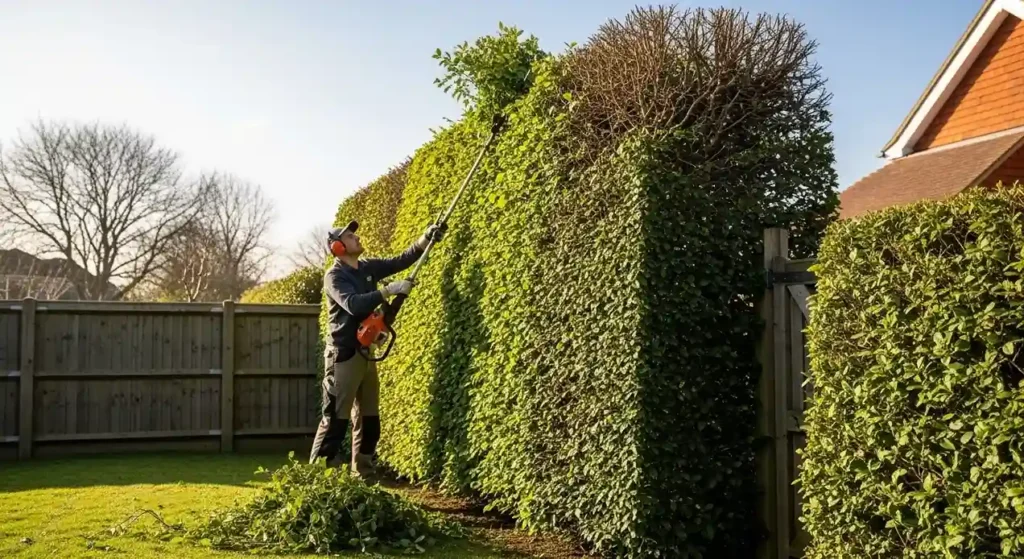
When you evaluate when to prune privet hedge the primary factor should always be light penetration. If you plan to maintain a six-foot screen you cannot afford to have a top-heavy canopy shifting the shade onto the lower roots. A professional “batter” or taper—where the base is wider than the top—removes the risk of bottom-thinning and leaves behind a lush wall that actually improves your garden privacy and wind protection over time.
I have witnessed homeowners spend years growing a hedge only to realize they have a five-foot “dead zone” at the bottom because they trimmed it perfectly vertical. Choosing a professional path with TreeRebral saves your privacy and ensures the frustrating bare patches are solved before the next growing season. It is the only way to guarantee a healthy hedge that looks like it was shaped by a master topiarist.
Mandatory Kit for a Successful Pruning Project
If you decide to take on a pruning project you will need a specific kit to ensure success. Proper preparation is the difference between a successful afternoon and a devastating month of staring at a mangled, brown hedge.
- A sharp pair of bypass loppers for achieving clean cuts on thicker internal branches without crushing the wood.
- A high-tension string line to guard against “wavy” tops and prying out a perfectly level horizon.
- Anti-fungal blade spray and heavy-duty gloves to initiate a sterile environment and stop the spread of leaf spot.
- A balanced slow-release fertilizer to help the plant recover and stimulate the next flush of green.
At TreeRebral we always suggest checking for active nests within a two-foot radius before every cut. Once the birds have fledged you can accurately judge if you have the right timing for the task or if you need to call in a specialist. This is often the most efficient way to manage when to prune privet hedge without breaking the law or harming local biodiversity.
How to Solve the Problem of Thin and Bare Growth
Identifying the Risks of Neglected Interiors
The leaf to wood ratio is often the hardest part to master but it must be addressed to stop light starvation in the center of the hedge.
Managing the Timing of Hard Renovation
Some old hedges need a “hard prune” back to the main trunk which can damage the look for a season but is proven to rejuvenate an aging plant.
Working with Variegated Varieties
Trying to prune variegated privet in deep shade is a recipe for disaster because the lack of chlorophyll makes it slower to recover than standard green types.
Smart Strategies for Wildlife Compliance
You will likely end up with more debris than you expect so plan for a compost station or green waste skip nearby.
Preserving the Ecological Health of Your Boundary
Pruning is not just a cosmetic job because it changes the micro-climate of your garden in ways that can be beneficial to your other plants. As the hedge is tightened it can pull airflow into the garden which leads to fewer pests and stronger rose blooms nearby. I have seen beautiful borders ruined because a privet was allowed to “umbrella” out, stealing all the nitrogen and light from the flowerbeds below.
By focusing on when to prune privet hedge now you are protecting the long-term value of your entire landscape. At TreeRebral we believe in proactive maintenance that removes disease vectors before they can jump to your prize-winning trees or shrubs. A well-kept hedge is a healthy hedge and fixing the flaws of a wild, overgrown boundary is the final step in that journey.
Frequently Asked Questions
What Is the Quickest Way to Make a Thin Privet Hedge Thicker?
If the base is sparse then cutting the top back by six inches is your only choice. However, I tell my clients that “terminal bud” pruning is the real secret. It still takes time for the lateral shoots to emerge but it is better than a tall, thin hedge that offers zero privacy.
Will Pruning in The Rain Damage My Hedge?
Yes, especially if you are using electric trimmers or if the plant is prone to fungal infections. If you do not tackle the pruning on a dry day, you will be inviting spores to enter the fresh cuts. This is why knowing when to prune privet hedge and checking the weather forecast is vital for a clean finish.
Is It Safe to Cut My Hedge Back During the Summer?
It is risky only if there are nesting birds present. Under the Wildlife and Countryside Act 1981, it is illegal to disturb them. I have seen projects halted for months because of a single robin’s nest. Always perform a deep internal check before you start the motor.
Can I Just Use a Chainsaw for An Overgrown Privet?
I strongly advise against this unless you are doing a total “reclamation” prune. Chainsaws tend to tear the bark which pulls the nutrient flow away from the new buds. Use a dedicated hedge trimmer or sharp loppers for a clean cut that heals within days.
Why Do Professional Arborists Prefer Manual Shears for Topiary?
Using a power trimmer for intricate shapes can cause massive collateral damage if your hand slips. Shears are surgical. At TreeRebral we can achieve a mirror-smooth finish on a spiral or sphere without disturbing the delicate inner structure of the plant.