
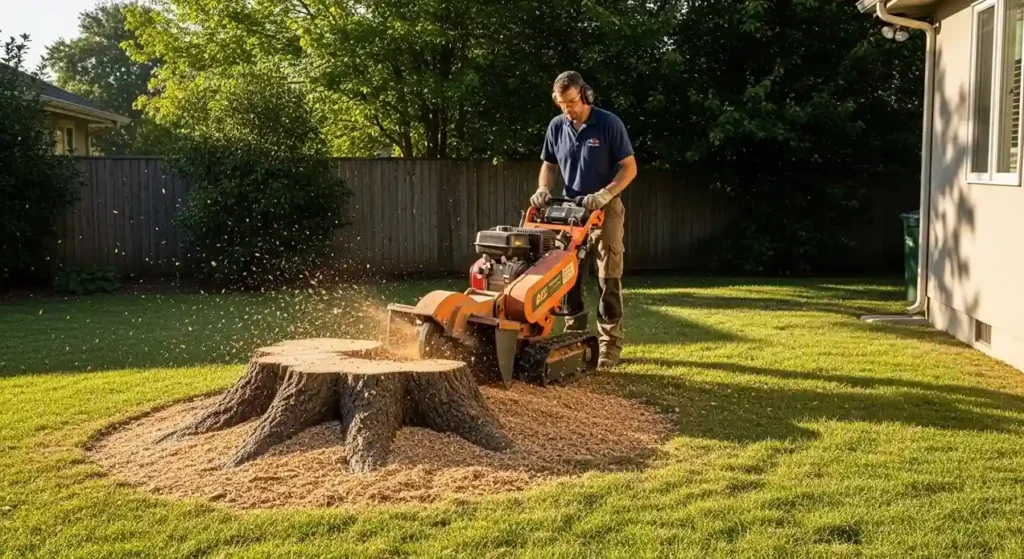
You’ve just had a tree taken down, and now that stump is sitting in your garden like it owns the place. Fair enough question: how long is this going to take? The honest answer ranges from a single afternoon to several years and the difference really does come down to which method you choose. Here’s a plain-English breakdown so you can make the right call for your garden, your budget, and your timeline.
Tree Stump Removal Times: Quick Summary
- Professional Stump Grinding: 1 to 4 hours (most common choice).
- Manual Removal (Small Stumps Only): half a day to a full day.
- Chemical Treatment: 4 to 8 weeks to soften, months to fully decompose.
- Natural Decomposition: 3 to 7 years without any help.
- Epsom Salt Method: 6 to 12 months minimum.
If you need the stump gone quickly, professional grinding wins every time. Everything else is a slower, more hands-on commitment.
Is It Actually Worth Removing the Stump at All?
Before anything else, it’s worth asking whether removal is necessary. Stumps can create real problems: they’re a tripping hazard (especially once grass grows over them), they attract ants, beetles, and occasionally honey fungus, and some species cherry, lime, poplar keep sending up new shoots from the base. That’s annoying if you’re trying to keep the garden tidy.
That said, if the stump is tucked away in a corner and not causing trouble, leaving it as a low-level wildlife habitat is a genuine option. The RHS notes that decaying stumps can support over 2,000 species of invertebrates. But if it’s in the middle of a lawn or near the house, removal almost always makes sense.
Method 1: Professional Stump Grinding (Fastest)
For most homeowners across the UK, professional stump grinding is the go-to solution. A qualified tree surgeon with a stump grinder can usually remove a stump in one to four hours. Small stumps under 30cm might be done in half an hour. Large hardwood stumps oak, beech, ash can take two to four hours, especially in tight spots or on sloped ground.
The machine chews the stump down 15 to 20cm below ground level, leaving wood chippings behind. Those chippings work well as garden mulch, or your contractor can remove them if you prefer.
In terms of cost, expect to pay somewhere between £150 and £500 for a standard residential stump. Larger stumps, awkward access, or stumps on slopes can push the price higher. If you’ve got several stumps, most contractors will offer a better rate for multiple jobs on the same visit.
Always use an ARB Approved Contractor for this kind of work they carry the right insurance and have the experience to handle complications, including underground roots near drains or service pipes.
Method 2: Manual Removal (Small Stumps Only)
If you’re dealing with a stump from a smaller ornamental tree under 20cm in diameter and you’re up for some physical work, manual removal is achievable. You’ll need a pickaxe, a sharp spade, and loppers. Budget for at least half a day, and expect it to be a genuine workout.
The approach involves digging around the stump, exposing the main roots, cutting through them, and then levering the whole thing out. For anything above 20cm, the root system becomes too extensive for this to be practical or safe without proper machinery. And for hardwood stumps from mature trees, it’s simply not realistic DIY territory.
Method 3: Chemical Stump Removal (Slow but Low Effort)
Chemical stump removers most commonly potassium nitrate-based work by accelerating the wood’s natural decomposition. You drill holes into the stump, apply the chemical, and wait. Softening begins within four to eight weeks; full breakdown takes six to twelve months or longer, depending on the species and size.
It’s a reasonable option if you’re not in a rush and would rather avoid the cost of professional removal. A few things to be aware of: don’t apply near waterways or children’s play areas, avoid using it in spring when the sap is rising (absorption drops significantly), and only use products with a valid HSE approval number. Species like willow, sycamore, and poplar respond particularly well to chemical treatment.
Method 4: Natural Decomposition (Eco-Friendly but Slow)
Left entirely alone, a stump will rot in time. Softwood stumps from pine or silver birch might go in two to three years. Hardwood stumps oak, beech, ash can take seven years or more. During that period, the stump becomes a home for fungi, insects, and invertebrates, which is great for biodiversity but may not be what you want in the middle of your lawn.
You can meaningfully speed things up. Drill holes in the top of the stump, pack them with nitrogen-rich fertiliser or compost, and keep the area consistently moist. This can cut months off the decomposition time. One thing to watch for: decaying stumps can harbour honey fungus, which spreads underground and can damage other plants and trees nearby.
What Actually Affects How Long the Job Takes?
Beyond the method, these factors all influence the timeline:
- Stump Size: A 10cm diameter stump is a completely different job to a 60cm one
- Tree Species: Hardwoods take significantly longer to grind and to decompose
- Root System: Deep tap roots or surface roots that spread wide add time and complexity
- Access: A stump in an open garden is straightforward; one down a narrow side passage, behind outbuildings, or on a slope takes longer
- Time of Year: Late autumn and winter are ideal in the UK the RHS notes this as the optimal period. Ground is moist but not frozen, and the grinder works efficiently in cooler, damper conditions
What Happens to the Garden After Removal?
After grinding, you’re left with a shallow hollow filled with wood chippings. If you want to turf or plant in that spot, you’ll need to clear the chippings and bring in fresh topsoil. The underground roots left behind decompose naturally over a few years this won’t cause structural problems for most gardens, but it’s worth knowing before you lay new grass over the area.
If the stump was excavated rather than ground, you’ll have a larger hole to fill. Your tree surgeon can advise on whether you need to import soil or whether the removed root material can be repurposed.
Should You Hire a Professional or Do It Yourself?
For stumps over 20cm, professional removal is the sensible route. The equipment, experience, and insurance are all there, and the job gets done cleanly in a single visit. For dependable results, consider Reliable Stump Grinding Bournemouth services. DIY stump grinding is possible hire centres do stock grinders but it carries real risk. Before operating one yourself, always get a proper demonstration from the hire company, wear full PPE including eye and hearing protection, and clear every stone from the working area beforehand. A stone hit at speed by a grinder can travel a very long distance.
Frequently Asked Questions
How Long Does Stump Grinding Actually Take?
Most stumps take between 30 minutes and two hours to grind. A very large or deeply rooted stump might take up to four hours. Access difficulties and hard wood species can add time.
Can I Remove a Tree Stump Myself?
For smaller stumps under 20cm, DIY is feasible with the right tools and commitment. For anything larger, professional removal is strongly recommended. It’s safer, faster, and the result is more reliable.
Will The Roots Die After the Stump Is Removed?
Yes. Once the stump is gone, the remaining roots lose their food source and decompose gradually over several years. For most gardens this causes no problems, but if you’re replanting in exactly the same spot, give the area time to fully settle first.
Do I Need Permission to Remove a Tree Stump in the UK?
If the original tree was protected by a Tree Preservation Order (TPO) or was within a Conservation Area, you may need to check with your local planning authority before proceeding. Your tree surgeon should flag this, but it’s always worth verifying yourself if you’re uncertain.
What Is the Best Time of Year to Remove a Tree Stump?
Late autumn through to early winter is generally considered the best period in the UK. The ground is moist, which helps with access and digging, and the grinder tends to work more efficiently in cooler conditions. Avoid frozen ground.
What Do I Do with The Wood Chippings?
They make excellent garden mulch spread them around flower beds or paths to suppress weeds and retain moisture. If the original tree was diseased, arrange for the chippings to be removed from site rather than spread in the garden.
How Long Does Chemical Stump Remover Take?
Typically, four to eight weeks to significantly soften the stump. Full decomposition takes six to twelve months or more, depending on species, size, and weather. Most effective during warmer months when the wood is actively absorbing moisture.