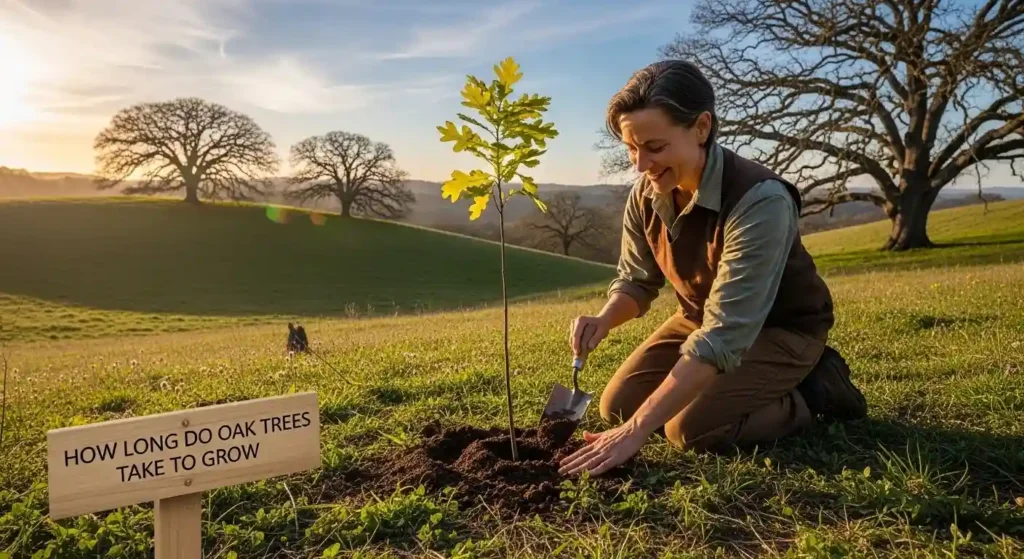
Most property owners view an acorn as a simple seed that should transform into a towering giant within a few seasons. I have seen this expensive misconception lead to poorly placed saplings that eventually interfere with power lines or foundations because the owner underestimated the scale of the long game. At TreeRebral, we have discovered that understanding how long oak trees take to grow is not just about measuring height but about respecting the century-long biological blueprint of the Quercus genus. For property owners seeking expert help, experienced Tree Surgeons Dorset professionals can provide guidance on planting and long-term care.
If you are looking for a permanent heritage feature you must recognize that the first decade is the most critical for structural survival. The real struggle occurs underground where the taproot remains active and must anchor deep into the substrate before the canopy can truly expand. This creates a botanical marathon and a window of vulnerability that can invite powdery mildew or squirrel damage into your young tree. Utilizing TreeRebral guidance ensures your sapling survives the risky early years to become a pillar of your garden.
Why a Fast Shade Result Is Often a Homeowner Fantasy
Many people assume that because they see fast growing oaks advertised, they will have a full privacy screen by year five. In my experience this is the most common myth in arboriculture because even the speediest species like the Northern Red Oak require decades to reach true maturity. When you investigate how long do oak trees take to grow through a rushed lens, you are essentially trying to bypass the natural lignification process that gives oak its legendary strength and density.
The most effective strategy involves choosing the right species for your soil pH and being prepared for a 20 year wait for the first acorn crop. At TreeRebral we recommend a realistic window of 30 to 50 years for a tree to reach a stately size, though they continue to thicken for centuries. If you ignore the slow pace of the White Oak, you will end up with a stubbornly small tree that refuses to thrive because it was forced into an unsuitable, high nitrogen environment.
Four Vital Stages of the Oak Growth Journey
1. The Seedling and Establishment Phase
If you start from an acorn, you can often win the fight by protecting the tender shoot from herbivores. You must focus on root development immediately to stop the plant from drying out during its first few summers when the system is still shallow and fragile.
2. The Sapling Surge and Height Gain
For larger challenges where the tree is competing for light, this is the undisputed king of vertical growth. This method is the favorite at TreeRebral because it is during these years that an oak can put on 1 to 3 feet of height annually, prying its way toward the upper canopy and establishing its central leader.
3. The Maturity and Canopy Expansion Phase
You can use structural pruning to manage the shape as the tree begins to focus on girth rather than just height. This method is highly effective but requires a timeframe of several decades to ensure the scaffold branches are strong enough to support the massive weight of a mature crown.
4. Avoiding the Trap of Veteran Neglect
Gaps in your long term care are a traditional mistake that works poorly as the tree enters its second century. You must use professional TreeRebral assessments to ensure the internal wood remains sound and free from Acute Oak Decline as the tree slows its vertical climb.
Why Structural Integrity Outweighs Rapid Vertical Gain
When you evaluate how long do oak trees take to grow the primary factor should always be the density of the timber. If you plan to leave a legacy for your grandchildren, you cannot afford to have a fast growing, weak wooded hybrid shifting the risk onto your home during a storm. A professional planting plan removes the risk of included bark and leaves behind a specimen that actually improves your local biodiversity supporting over 2000 species as it ages.
I have witnessed homeowners spend thousands on instant large trees only to realize they lack the root to canopy ratio to survive the transplant. Choosing a professional path with TreeRebral saves your investment and ensures the ugly dieback is avoided by planting younger, more adaptable stock. It is the only way to guarantee a healthy giant that looks like it has been part of the landscape for a thousand years.
Mandatory Kit for Tracking Your Oak Growth
If you decide to plant a legacy tree you will need a specific set of tools to ensure success. Proper preparation is the difference between a successful planting and a devastating loss of a future landmark.
- A heavy duty auger or spade for achieving a wide, shallow planting hole that encourages lateral root spread.
- A breathable spiral guard to guard against bark stripping by rabbits and prying deer.
- High quality organic mulch to initiate a stable moisture zone and stop weed competition.
- A sturdy timber stake and flexible tie to ensure the sapling stays upright during winter gales.
At TreeRebral we always suggest checking the drip line radius every spring to avoid hitting the delicate feeder roots with lawnmowers. Once the tree is established, you can accurately judge if you have the right timing for the task or if the canopy needs a crown lift. This is often the most efficient way to manage how long do oak trees take to grow without compromising the safety of your property.
How to Solve the Problem of Stunted Oak Growth
Identifying the Risks of Soil Compaction
The oxygen to root ratio is often the hardest part to master under a lawn but it must be protected to stop root suffocation in aging oaks.
Managing the Timing of Acorn Production
Some species like the English Oak take up to 40 years to fruit which can damage your expectations if you are looking for wildlife forage sooner.
Working with Diverse Oak Species
Trying to grow a moisture loving Pin Oak on a dry chalk hillside is a recipe for disaster because the lack of iron makes a healthy lifespan nearly impossible.
Smart Strategies for Pest Resilience
You will likely end up with more galls and caterpillars than you expect, so planning for a natural predator habitat nearby is essential to keep the tree balanced. Following professional arboriculture guidance from the Arboricultural Association can help you manage pests effectively while protecting long-term tree health.
Preserving the Ecological Heart of Your Garden
An oak is not just a tree because it creates a massive micro ecosystem that changes the temperature of your garden. As the canopy thickens it can pull carbon out of the atmosphere which leads to a cooler, more resilient property. I have seen beautiful gardens ruined because a massive oak was allowed to develop asymmetric growth without any thought for the weight distribution over the house.
By focusing on how long do oak trees take to grow now you are protecting the long term health of your entire neighborhood. At TreeRebral we believe in proactive care that removes deadwood risks before they can jump to your luxury outdoor furniture or expensive outbuildings. A majestic oak is a healthy oak and fixing the flaws of a neglected sapling is the final step in that journey.
Frequently Asked Questions
What Is the Quickest Way to Make an Oak Tree Grow Faster?
If the soil is poor then a deep root fertilization program is your only choice. However, I tell my clients that patience is the best fertilizer. It still takes time for the cambium layer to thicken but it is better than a forced tree that lacks the structural strength to handle the wind.
Will The Roots Damage My Pipes If I Plant an Oak?
Yes, especially if you choose a species with a wide spreading root plate like the Sessile Oak. If you do not tackle the distance issue now you will be digging up your drains in thirty years. This is why knowing how long do oak trees take to grow and their ultimate spread is vital for urban planning.
Is It Safe to Prune a Young Oak in The Summer?
It is risky because the smell of fresh cuts can attract pests like the Oak Processionary Moth or Bark Beetles. I have seen trees decline rapidly after a summer hack. Always aim for a winter prune when the tree is dormant and the disease vectors are less active.
Can I Just Leave a Fallen Acorn to Grow Where It Lands?
I strongly advise against this if it is too close to your walls. While the natural look is great, the taproot of a self-sown oak is incredibly difficult to move after just two years. If you find a lucky sprout, move it to a permanent spot while it is still under twelve inches tall.
Why Do Professional Arborists Prefer Local Native Oaks?
Planting an exotic species in a UK garden can cause massive collateral damage to the local food chain. Native oaks are surgical. At TreeRebral we can help you select a Quercus robur that will thrive in your specific soil without disturbing the delicate balance of the local ecosystem.